Sebagai bentuk dukungan terhadap “Life On Land di Indonesia” Universitas Sumatera Utara adalah berkomitmen menjaga kehidupan di daratan yang berkelanjutan di seluruh Indonesia. Di tengah tantangan perubahan lingkungan dan urbanisasi yang cepat, kami bertujuan untuk melindungi keanekaragaman hayati, mengurangi deforestasi, dan mempromosikan praktik pengelolaan sumber daya alam yang berkelanjutan. Dalam program ini, USU membentuk kerja sama dengan pemangku kepentingan utama, pemerintah, dan masyarakat lokal untuk merancang dan melaksanakan kegiatan konservasi dan rehabilitasi lahan. Dengan memprioritaskan penanaman pohon, restorasi ekosistem, dan pelestarian habitat alam yang terancam. Selain itu, Universitas Sumatera Utara juga aktif melakukan riset dan pengembangan untuk menciptakan solusi inovatif dalam pengelolaan sumber daya alam yang ramah lingkungan. Mari bersama-sama mencapai tujuan pembangunan berkelanjutan "Life On Land di Universitas Sumatera Utara". Bersama-sama, kita dapat menciptakan lingkungan daratan yang sehat, lestari, dan memberikan manfaat jangka panjang bagi masyarakat dan alam sekitar.
Proportion of Students Receiving Financial Aid to Attend University Because of Poverty
In 2024, Universitas Sumatera Utara had 41,570 students, showing a slight decrease from 42,996 in 2023. Of this total, 86.6% (36,000 students) are undergraduates, with 13.4% (5,570) in master's, doctoral, and professional programmes. Universitas Sumatera Utara maintains a student-to-faculty ratio of 1:24, improving from 1:25 in 2023. The student body is nationally diverse, with 65% from North Sumatra, 20% from other Sumatra provinces, 10% from Java and Kalimantan, and 5% from Eastern Indonesia. This distribution positions Universitas Sumatera Utara as a leading institution for Western Indonesia, promoting social mobility through national admission systems like National Selection Based on Achievement, National Selection Based on Test, and Independent Pathway Exam.
In 2024, Universitas Sumatera Utara continued its strong commitment to social inclusion, providing financial aid to 8,250 students. Of these, 6,636 benefited from the Kartu Indonesia Pintar Kuliah programme, offering full tuition and living stipends for low-income students. Additionally, 119 students received aid through KIP Kuliah Usulan Masyarakat for those from disadvantaged regions. Universitas Sumatera Utara also allocated support via Bantuan Belajar Mahasiswa, Baznas scholarships, and external partners like PT Martabe and BCA. Specialized programs like Beasiswa Afirmasi Pendidikan Tinggi and Beasiswa Barista National Research and Innovation Agency further supported vulnerable groups. Around 19,7% of Universitas Sumatera Utara's student body, primarily from rural and semi-urban areas, received assistance, promoting social mobility and contributing on poverty eradication and inclusive education.
University Anti-poverty Programmes
Bottom Financial Quintile Admission Target
As a state university owned by the government, the University of North Sumatra (USU) has a responsibility to support the government's program, which aims to achieve a Gross Enrollment Ratio (GER) of 31.45% in higher education by 2023. In 2023, USU awarded scholarships to 9,311 undergraduate students, which accounts for approximately 30% of the total undergraduate student population at the university.
Bottom financial quintile student success
The University of North Sumatra (USU) remains consistent in meeting the government's target for the Gross Enrollment Ratio (GER) in higher education, set at 31.45%. USU supports this goal by providing full scholarships (covering the Tuition Fee (UKT) for Group I and II) to the lowest 20% of household income earners in Indonesia. These scholarships are granted for a duration of 3 to 5 years, until graduation.
Bottom Financial Quintile Student Support
Universitas Sumatera Utara mempunyai program atau inisiasi untuk mendampingi mahasiswa dari golongan 20% pendapatan rumah tangga terendah (atau target yang lebih sempit) agar berhasil menyelesaikan kuliahnya, diantaranya (1) program pendampingan oleh dosen pembimbing akademik, dimana setiap mahasiswa memiliki 1 dosen pembimbing akademik yang bertugas untuk memantau perkembangan prestasi mahasiswa setiap semester; (2) layanan bimbingan dan konseling untuk mahasiswa oleh psikolog universitas yang dapat diakses secara gratis; dan (3) beberapa kegiatan pengembangan diri bagi penerima beasiswa
Low-income Student Support
The University of North Sumatra (USU) demonstrates its commitment to supporting students from the lowest 20% of household income earners by providing various free and subsidized services, including: Transportation: USU Shuttle Bus / USU Bike (Free) Healthcare: Polyclinic and General Hospital (Subsidized) Dormitories: Subsidized dormitory accommodation Legal Assistance: Free legal assistance Counseling (Psychological Services): Free psychological counseling services Spiritual Services: Mosque and Church facilities for spiritual activities (Free) Sports: Free access to sports facilities and activities Recreational Activities: Free recreational services Additionally, USU provides free meals to students after Friday prayers, distributed by the mosque committee, further ensuring that students from low-income backgrounds receive the support they need for both their academic and personal well-being. These initiatives are part of USU's effort to reduce the financial burden on students from disadvantaged families, making higher education more accessible and ensuring a holistic, supportive environment for all students.
Low or Lower-middle Income Countries Student Support
The University of North Sumatra (USU), as a state university, participates in government programs aimed at supporting students from developing countries, such as the Developing Countries Partnership Program (KNB). In 2024, based on the letter from the Ministry of Education, Culture, Research, and Technology of the Republic of Indonesia, number 419/E3/KM.00.01/2024, several students from developing countries were admitted to USU under this program. These students include: 2 undergraduate students 3 master's students 1 doctoral student This initiative is part of USU’s commitment to fostering international cooperation and offering educational opportunities to students from developing countries, helping to strengthen academic and cultural ties globally while contributing to the development of human resources in these nations.
Community Anti-poverty Programmes
Local Start-up Assistance
USU supports local communities and student entrepreneurs through education, mentoring, and innovation programmes to develop sustainable and socially responsible businesses. Managed by Community Service, Directorate of Student Achievement and Alumni Affairs, and the Business Innovation Center, initiatives include entrepreneurship training, incubation, and Desa Binaan projects. In 2024, USU assisted 137 student-led start-ups and 40 community enterprises, benefi ting 1,200 participants across 15faculties, with total funding of Rp 1.7 billion. Supported by partners including Bank Indonesia, National Research and Innovation Agency, PT Inalum, and the Ministry of Cooperatives, USU provides co-working spaces, laboratories, and mentoring facilities. Desa Binaan villages promote eco-products, agro-tourism, and sustainable farming. Through this inclusive ecosystem, USU advances No Poverty and Decent Work and Economic Growth by empowering communities and fostering responsible innovation.
Local Start-up Financial Assistance
USU provides financial assistance and seed funding to support the creation of financially and socially sustainable community enterprises. Through the Institute for Community Service, Directorate of Student Achievement and Alumni Affairs, and faculty-based programs, over Rp 1.7 billion in grants was distributed in 2024 to local entrepreneurs and student–community collaborations. Funding ranged from Rp 5-25 million per enterprise, supporting 130 student-led start-ups and 40 microenterprises in sustainable agriculture, creative industries, food innovation, and green technology. The Desa Binaan programme allocated Rp 100 million per village for business incubation and cooperative formation in 12 rural communities, enabling ventures such as eco-tourism and organic fertilizer production. Supported by Bank Indonesia, PT Inalum, and the National Research and Innovation Agency, these mechanisms strengthen local capacity and advance No Poverty and inclusive economic growth.
Programmes for Services Access
USU significantly expanded access to essential services (health, education, sanitation, infrastructure) in North Sumatra in 2024. The Institute for Community Service executed 429 projects, engaging 5,200 students and 780 lecturers from 17 faculties, benefiting over 80,000 residents. The Desa Binaan programme invested Rp 100 million per village in 12 villages, improving clean water, sanitation, and healthcare access for 10,000 residents. USU’s health outreach was substantial: Teaching and Dental Hospitals conducted 45 activities (free check-ups, vaccinations, stunting prevention), benefiting 18,000 people. The Faculty of Nursing trained 480 rural health volunteers through 17 workshops, boosting local health capacity. Furthermore, USU's Digital Transformation initiative enhanced public access by integrating 30,000 student records and digitising 271 websites. These collective efforts robustly promote equitable access to basic services, ensuring no community is left behind.
Policy Addressing Poverty
Universitas Sumatera Utara actively contributes to poverty eradication through research, partnerships, and community empowerment. Collaborating with the North Sumatra Provincial Government and social agencies, Universitas Sumatera Utara helped design poverty-reduction policies benefiting 37,000 low-income households in 48 villages. At the national level, Universitas Sumatera Utara academics advise the Ministry of Social Affairs and the Ministry of Villages, contributing to research clusters worth Rp 4.8 billion funded by Directorate General of Ministry of Higher Education, Science, and Technology and National Research and Innovation Agency. In 2024, Institute for Community Service implemented 429 community projects benefiting 80,000 people, focusing on women’s entrepreneurship, nutrition, and sustainable farming. Through collaboration with the ASEAN University Network, Universitas Sumatera Utara advances inclusive development and evidence-based policymaking for poverty alleviation.


.webp)
PRIORITY STATEMENTS
Indonesia membutuhkan Anda, para akademisi yang berkomitmen untuk membawa perubahan nyata. Kami mengundang Anda untuk berbagi penelitian, inovasi, dan ide-ide brilian Anda guna melawan kemiskinan, meningkatkan kesejahteraan sumber daya manusia (SDM) dalam negeri, dan menyukseskan masa depan Republik Indonesia.
Structure, composition and diversity of tree species in Martelu Purba Nature Reserve, North Sumatra, Indonesia
Rangkuti A.B., Hartini K.S., Susilowati A., Rambey R., Harahap M.M., Arinah H., Irmayanti L., Pamoengkas P., Indriani F., Peniwidiyanti, Ruhidi A.
Spatial distribution of 2019 forest and land fires in Indonesia
Thoha A.S., Istima N., Daulay I.A., Hulu D.L.N., Budi S., Ulfa M., Mardiyadi Z.
Ethnobotany of Medicinal Plants Community in Saroha Village, Tanjung Botung, Barumun District, Padang Lawas Regency, Uatara, North Sumatra
Rambey R., Lubis A.S.J.
Analysis of Eucalyptus Supply Chain Methods Based on Influencing Factors: A Review
Sembiring N., Napitupulu H.L., Azmi N.N., Radot R.
Forest Stand Composition of the Tapanuli Orangutan (Pongo tapanuliensis) Habitat in the Nature Reserves
Maulana M.I., Auliah N.L., Onrizal O.
Biology of Elaeidobius kamerunicus in the lowland and highland on North Sumatra, Indonesia
Rozziansha T.A.P., Fitraini A.A., Girsang R.J., Priwiratama H., Prasetyo A.E.
State of human tiger conflict around Gunung Leuser National Park in Langkat Landscape, North Sumatra, Indonesia
Patana P., Alikodra H.S., Mawengkang H., Hamdani Harahap R.
Distribution of highland cassava genotypes in soil nutrient gradient of Toba District, North Sumatra, Indonesia
Sebayang N.U.W., Syahputra E., Setiawan A.
A Comparative Study of Phytochemical Screening and DPPH Radical Scavenging Activity of Ficus carica Linn. Leaves Extracts
Reveny J., Maha H.L., Laila L.
Prospects and challenges of environmental DNA (eDNA) metabarcoding in mangrove restoration in Southeast Asia
Wee A.K.S., Salmo S.G., III, Sivakumar K., Then A.Y.H., Basyuni M., Fall J., Habib K.A., Isowa Y., Leopardas V., Peer N., Artigas-Ramirez M.D., Ranawana K., Sivaipram I., Suleiman M., Kajita T.
Leaf morphological traits of nine major tropical trees of Shorea species (Dipterocarpaceae)
Mufarhatun N., Susilowati A., Hilwan I., Arrofaha N., Yulita K.S., Dwiyanti F.G., Hidayat A., Kamiya K., Rachmat H.H.
Model of Phytoplankton Diversity in Belawan River, North Sumatera, Indonesia
Yeanny M.S., Barus T.A., Mawengkang H., Mulya M.B.
Population and autecology of the endangered Rafflesia meijeri in Batang Gadis National Park, Indonesia
Rambey R., Saputra N., Rambe I.F., Nopandry B., Zunaidi S., Christy E.L., Setiawan T., Afifuddin Y., Hartanto A.
Floristic composition and carbon stock estimation under restored mangrove area in Bagan Serdang, North Sumatra, Indonesia
Harefa M.S., Nasution Z., Tuhono E., Susilowati A.
Diversity and species composition of lichens across altitudinal range in the Batang Toru Forest, North Sumatra, Indonesia
Pasaribu N., Atni O.K., Siregar J.P.
Floristic composition and structure of Eurycoma longifolia habitat in Muka Kuning Nature Tourism Park, Riau Islands, Indonesia
Susilowati A., Rachmat H.H., Yulita K.S., Wijaya K.
Mangrove cover change (2005–2019) in the Northern of Medan City, North Sumatra, Indonesia
Rahmawaty, Siahaan J., Nuryawan A., Harahap M.M., Ismail M.H., Rauf A., Kurniawan H., Gandaseca S., Karuniasa M.
Habitat characteristics and biodiversity of nekton in the Alas-Singkil River Basin, Northern Sumatra, Indonesia
Muhtadi A., Leidonald R., Fauzia A.D.
Study of Community Forest Management (HKm) on Socio-Economic Sustainability in Several Regions of Indonesia
Latifah S., Yonariza, Purwanto
The Effect of Changes in Forest Area Designation on a Diversity of Undergrowth Vegetation
Sidabukke S.H., Simarmata M.M.T., Saragih R., Rasyid F., Aulin F.R.
Analysis of the Potential of Non-Timber Forest Products at Siarsikarsik Village Forest Management Institute, Lumban Julu Village, Lumban Julu District, Toba Regency
Jauhari M.A., Rahmawaty, Samsuri
Distribution Pattern of Shorea lepropsula Miq, Around the Forest Area with Special Purpose (KHDTK) Aek Nauli Indonesia
Latifah S., Zahra M., Panggabean M.D.
The diversity of utilizations, tapping flow discharge, and conservation of sugar palm (Arenga longipes Mogea) cultivated in Langkat, North Sumatra, Indonesia
Fadhilla S., Hakim L., Agustian A., Lubis Y.S., Siregar A.W.
Potential of Phylloplane Fungi from Mangrove Plant (Rhizophora apiculata Blume) as Biological Control Agents against Fusarium oxysporum f. sp. cubense in Banana Plant (Musa acuminata L.)
Shara M., Basyuni M., Hasanuddin
Optimization Model of Integrated Sustainable Forest Management Planning for Hydropower Power Plant
Br Sinaga J.A., Tulus T., Mawengkang H., Nasution M.K.M.
Effects of Sweet Potato (Ipomoea batatas) Starch Edible Coating, White Turmeric (Curcuma zedoaria) Extract and Glycerol to Stored Strawberries
Zaidar E., Arifa D., Hardiyanti R.
Rice Husk is Renewable Source in Synthesis Nanosilicon and Its Application as Potential Anode Lithium-Ion Batteries
Daulay A., Andriayani, Marpongahtun, Gea S.
Oxidation of Breadfruit Starch (Artocarpus altilis) using Hydrogen Peroxide
Zuhra C.F., Sinaga M.Z.E., Suharman S., Nasution R.A.S., Nurhadija S.
Qualitative Determination of Secondary Metabolites and Antioxidant Activity of Betel (Piper betle L.)
Lenny S., Sembiring H.B.
Isolation and Identification of Flavonoida Compound from Hujan Emas Leaves (Galphimia speciosa C. E. Anderson)
Sembiring H.Br., Zahara A.
Soil Carbon Organic and Cation Exchange Capacity (CEC) on Rubber Agroforestry Land and Rubber Monoculture Land, Simalungun Regency, North Sumatra, Indonesia
Muhdi, Elfiati D., Hanafiah D.S., Manalu A.C.P., Naibaho E.
Edible Coating of Tomato (Solanum lycopersicum) using Carboxymethyl Cellulose (CMC) from Bagasse
Sinaga M.Z.E., Bulan R., Hardiyanti R., Zaidar E., Zuhra C.F., Lenny S., Thalia N.
Charaterization of Nanocellulose from Liquid Wasted of Tofu by Acetobacter xylinum
Purba H., Marpongahtun, Andriayani, Septevani A.A., Sitepu E.
Mechanical properties of bioplastic corn starch with nanofiber cellulose from oil palm mesocarp fibers and glycerol as plasticizer
Ayu G.E., Lubis M., Ginting M.H.S., Hayat N., Hasibuan M.S.
Taxonomic Diversity of Lianas in the Batang Toru Forest, North Sumatra
Pasaribu N., Siregar A.F., Siregar J.P., Atni O.K., Hartanto A.
Optimizing the Synthesis of Silver Nanoparticles Using Five Curcuma Species under UV Irradiation as a Potent Suncreen Substrate
Widikdo W., Sugita P., Khotib M., Restu W.K., Rahmayeni R., Agusnar H.
Effect of Soil Compaction due to Organic Matter and 4-Wheel Tractor Traffic on Sugarcane Growth
Rizaldi T., Putri F.N.E., Rifai M.
Land characteristics and land suitability assessment for Styrax sp. in Humbang Hasundutan Regency, North Sumatra, Indonesia
Rahmawaty, Ismail M.H., Rauf A., Batubara R., Elena Sitorus E.W., Simamora Z., Ginting E.F.
INVENTORY AND IDENTIFICATION OF PARASITOID EGGS AND LARVAE OF Spodoptera frugiperda (LEPIDOPTERA: NOCTUIDAE)
Tobing M.C., Waruwu A., Hutabarat T.T., Siregar A.Z., Sitepu S.F., Widihastuty
Annual Tree-Ring Curve-Fitting for Graphing the Growth Curve and Determining the Increment and Cutting Cycle Period of Sungkai (Peronema canescens)
Bahtiar E.T., Iswanto A.H.
Aboveground biomass and carbon stock estimation using UAV photogrammetry in Indonesian mangroves and other competing land uses
Basyuni M., Wirasatriya A., Iryanthony S.B., Amelia R., Slamet B., Sulistiyono N., Pribadi R., Sumarga E., Eddy S., Al Mustaniroh S.S., Sasmito S.D., Sidik F., Kajita T., Ali H.M., Macklin P.A., Arifanti V.B.
Effect of regional planning on social welfare in the Islands and mainland of Aceh Province
Kurnia H., Masbar R., Sirojuzilam, Zulham
An Extreme Learning Machine Based Adaptive VISMA for Stability Enhancement of Renewable Rich Power Systems
Setiadi H., Shah R., Islam M.R., Asfani D.A., Nasution T.H., Abdillah M., Megantoro P., Krismanto A.U.
Potential of keratinolytic fungi isolated from chicken and goat farms soil, North Sumatra
Aritonang R., Mamangkey J., Suryanto D., Munir E., Hartanto A.
Analysis of land cover changes due to forest fires in Gunung Leuser National Park, North Sumatra Province, Indonesia
Thoha A.S., Saraswita N., Sulistiyono N., Wiranata D., Sirait S.M., Inaldi R.
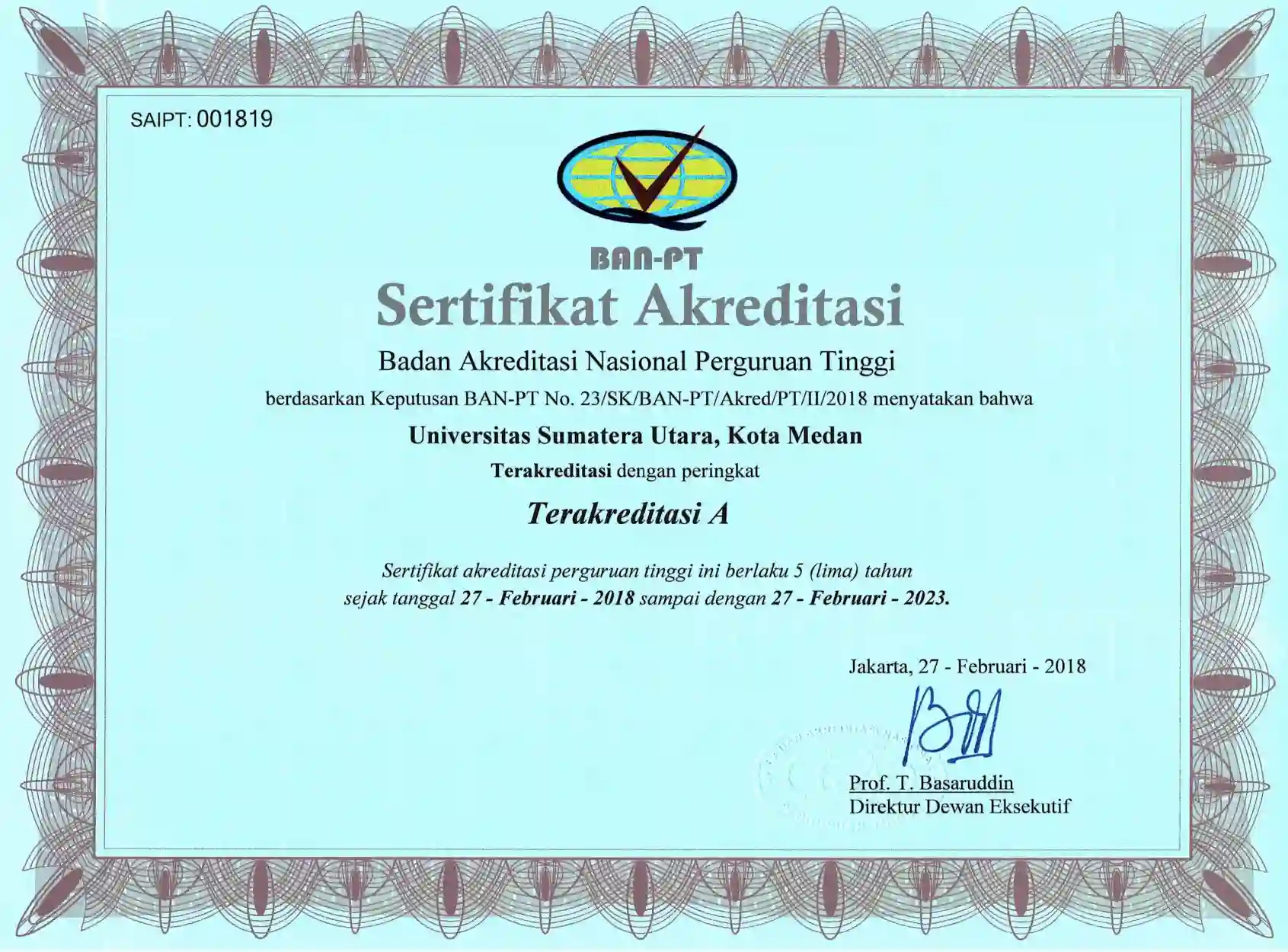
Akreditasi Fasilkom-TI