


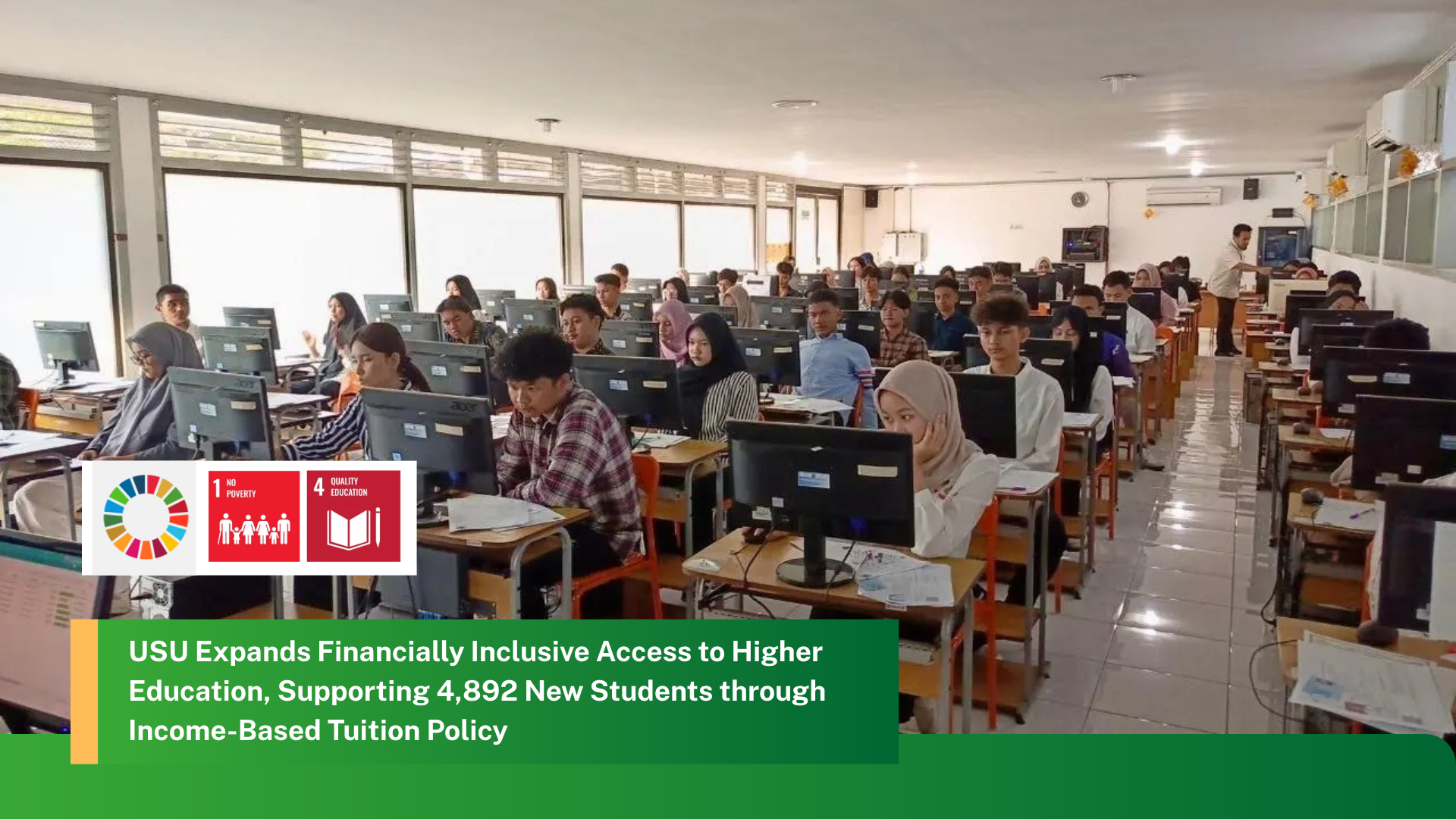
In 2025, USU admitted 10,111 new students across its academic programmes and admission pathways. As part of its commitment to ensuring equitable access to higher education, the University applies a Single Tuition Fee (Uang Kuliah Tunggal or UKT) system in which tuition levels are determined by the economic capacity of students, their parents, or other parties responsible for financing their education.
For new Diploma and Undergraduate students, economic information submitted by students is subject to verification and validation as part of the UKT determination process. This approach enables the University to differentiate tuition contributions according to the financial circumstances of individual households rather than applying a uniform tuition burden to all students.
4,892 New Students Benefited from Tuition Levels Below the Highest Category
USU's 2025 student registration data show that 7,692 new Diploma III, Diploma IV, and Bachelor's students were registered through the relevant regular and independent admission pathways.
Of these students, 4,892, or approximately 63.6%, were assigned UKT levels below the highest tuition category applicable to their respective programmes.
The 4,892 students comprised:
252 Diploma III students
429 Diploma IV students
4,211 Bachelor's students
This distribution demonstrates the reach of USU's differentiated tuition policy in limiting the number of students required to pay the maximum tuition level.
The UKT mechanism is directly linked to household economic capacity. Students provide socioeconomic information and supporting documents that are verified and validated by the University before the appropriate tuition category is determined. Students who consider their tuition assessment inconsistent with their actual economic circumstances are also provided with a mechanism to request a reassessment or appeal.
Through this system, USU seeks to ensure that the cost of higher education remains proportionate to students' financial circumstances and that economic constraints do not unnecessarily limit access to university education.
Supporting Students Facing Financial Barriers
Income-based tuition determination is complemented by financial assistance programmes targeted at students who require additional support.
One of the major programmes available to USU students is Kartu Indonesia Pintar Kuliah (KIP Kuliah/KIP-K), a national higher-education assistance programme designed to expand access to university education for academically eligible students facing economic constraints.
In the 2025 SNBP admission process alone, 918 prospective USU students were recorded as KIP-K recipients. The programme provides an important pathway for students from financially disadvantaged households to access higher education without tuition costs becoming an overriding barrier to participation.
USU also facilitates access to a broad range of scholarship opportunities. In 2025, students had access to more than 40 scholarship schemes originating from government institutions, the University, private-sector partners, foundations, and other organisations.
The support available through these schemes may include tuition assistance, living allowances, educational expenses, academic development, and other forms of student support.
Among these initiatives, USU also provided a Merit Scholarship Programme for 250 students, with financial assistance of IDR 2.1 million per student per semester for one year. Students could additionally access external programmes offering tuition and living-cost assistance, mentoring, skills development, and academic support.
Together, these mechanisms form part of USU's wider approach to improving the affordability and accessibility of higher education.
Reducing the Risk of Financial Exclusion from Higher Education
Financial constraints remain an important barrier to participation and continuation in higher education. Students from households with limited economic resources may face greater risks of delaying enrolment, discontinuing their studies, or being unable to access university education altogether.
USU addresses this challenge through a combination of income-sensitive tuition assessment, tuition assistance, scholarships, KIP Kuliah, and mechanisms for tuition reassessment.
Rather than treating financial support solely as an administrative mechanism, USU positions affordable access to higher education as part of its contribution to reducing socioeconomic vulnerability.
Education can create longer-term opportunities for individuals to increase their knowledge and professional capabilities, improve employability, strengthen social mobility, and enhance their future economic resilience.
Contributing to SDG 1 – No Poverty
USU's approach directly contributes to the objectives of Sustainable Development Goal 1: No Poverty, particularly through institutional measures intended to reduce financial barriers faced by students and families in accessing higher education.
In 2025, the combination of 10,111 newly admitted students, 4,892 Diploma and Undergraduate students assigned tuition below the highest UKT level, 918 KIP-K recipients recorded through the SNBP pathway, and access to more than 40 scholarship schemes demonstrates the scale and diversity of mechanisms available to support more inclusive participation in higher education.
These initiatives also contribute to SDG 4 – Quality Education, particularly the objective of expanding equitable access to affordable and quality tertiary education.
Through data-based tuition determination, financial assistance, scholarships, and student support mechanisms, Universitas Sumatera Utara continues to develop a higher education environment in which a student's economic circumstances are considered in determining the financial burden of study.
For USU, widening access to higher education is not only an educational commitment but also an important component of the University's contribution to reducing socioeconomic inequality and supporting pathways out of poverty.