


Medan, Indonesia. Universitas Sumatera Utara (USU) is integrating water reuse into campus resource management through university-wide environmental guidance and water recovery practices at academic, healthcare and supporting facilities. The approach combines reuse of appropriately treated wastewater, recovery of water from daily activities and rainwater harvesting to reduce demand for fresh water in non-potable uses.
University-Wide Policy for Water Conservation and Reuse
Universitas Sumatera Utara establishes university-wide water reuse provisions through Rector's Decree No. 3132/UN5.1.R/SK/KPM/2024 on Campus Security, Safety, and Health (K4), issued on 24 September 2024. Chapter IV, Section D sets out institutional measures for domestic and laboratory wastewater management, including reducing wastewater generation, encouraging the reuse of domestic wastewater, and managing wastewater treatment across university units. The guidelines specifically identify the reuse of water from ablution activities for landscape irrigation and the collection of laboratory wastewater for appropriate treatment. These provisions provide a university-level policy framework for expanding water reuse and reducing reliance on freshwater resources across campus operations.
This framework builds on Rector’s Circular Letter No. 1 of 2023 on environmental management and USU’s commitment to becoming a green, sustainable and carbon-neutral campus by 2029. The circular establishes university-wide directions for responsible resource management, environmentally friendly infrastructure and environmental monitoring.
Treated Wastewater Reuse in Campus Buildings
USU’s 2025 Green Campus and UI GreenMetric Report describes the sewage treatment system at the Digital Learning Center Building, where treated wastewater can be reused for non-potable applications, including toilet flushing. This facility connects water treatment to practical reuse within building operations.
Water Recovery for Landscape Maintenance
At the Faculty of Medicine, water recovered from ablution activities is collected for watering plants and maintaining green areas. The Green Campus report also describes water recycling practices associated with USU Hospital and landscape maintenance, illustrating uses of recovered water outside drinking-water applications.
Rainwater Harvesting Complements Water Reuse
Alongside wastewater recovery, USU documents rainwater collection systems at the Faculty of Engineering, the Mini Stadium area, the Information Study Center and near the Central Administration Building. The 2025 Green Campus and UI GreenMetric Report identifies storage of 2,000 litres at the Faculty of Engineering and 150,000 litres in the Mini Stadium area. Harvested rainwater supports non-potable activities such as landscape irrigation and vehicle washing, complementing the reuse of wastewater.
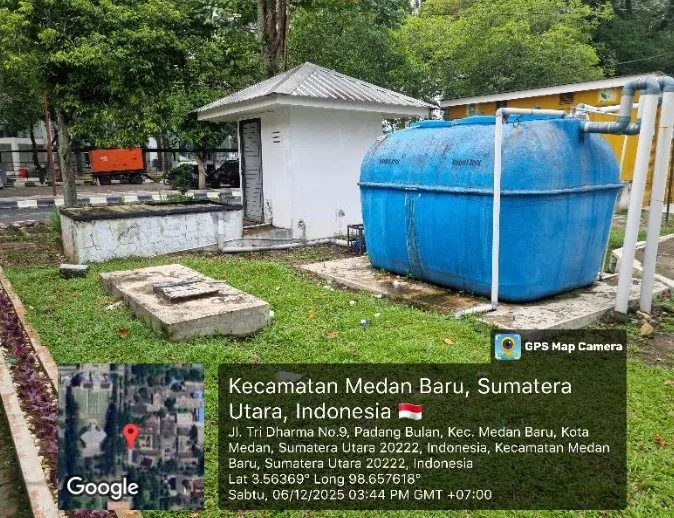
USU also maintains wastewater treatment infrastructure as part of its institutional water management. The university's 2025 procurement contract register documents maintenance arrangements for the wastewater treatment installation at USU Hospital during July–December 2025. These operational arrangements complement the university's water conservation and reuse initiatives by supporting wastewater treatment infrastructure within campus healthcare facilities.
Through Rector's Decree No. 3132/UN5.1.R/SK/KPM/2024, Universitas Sumatera Utara establishes an institutional framework that promotes water reuse across university operations. The application of treated wastewater for toilet flushing, recovered water for landscape irrigation, and rainwater harvesting for non-potable purposes demonstrates how these conservation principles are supported by facilities and practices across campus. By connecting university-wide policy with practical water recovery and reuse initiatives, USU advances responsible water resource management and contributes to SDG Target 6.4 on improving water-use efficiency.