


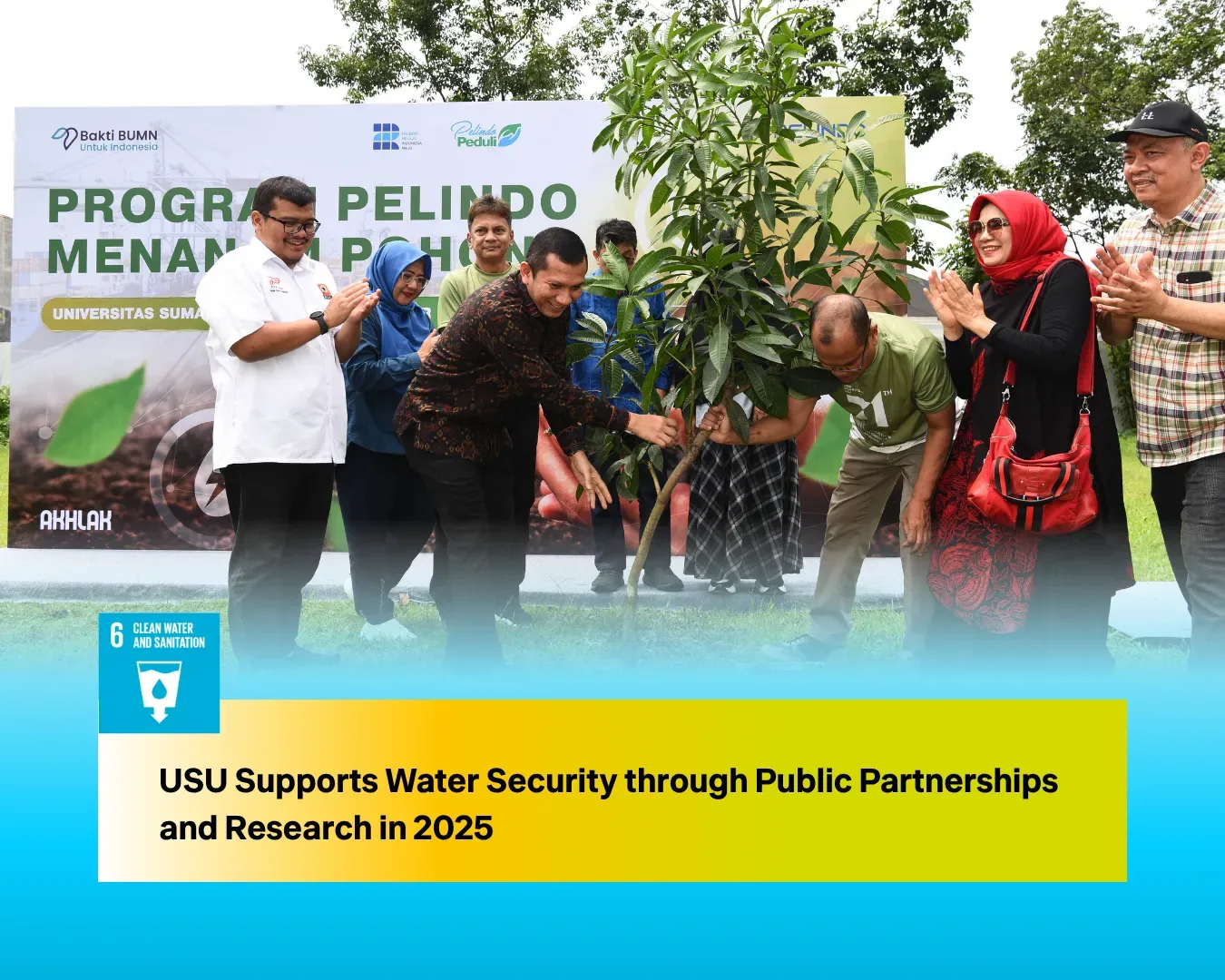
Medan, Indonesia. Universitas Sumatera Utara (USU) contributed to water-related governance and research in 2025 through work concerning a regional drinking water utility, municipal flood-management infrastructure and freshwater resource assessment. Records for the year connect legal expertise, campus infrastructure and hydrological research with public water-management needs.
At the Faculty of Law, the 2025 research entry in Yusrin’s official academic record lists a project to review and prepare an academic paper and draft regional regulation on additional capital participation by Deli Serdang Regency in Perumda Tirta Deli. The record names Yusrin and Syarifah Lisa Andriati. This work addresses the legal basis for regional investment in the drinking water utility, providing a relevant academic contribution to public water-service governance.
Municipal cooperation is also documented in reporting published on 15 October 2025, which identifies the university’s retention pond as a Medan City Government programme developed with Universitas Sumatera Utara. A representative of the city’s Water Resources, Highways and Construction Agency discussed drainage constraints following flooding that month. The account confirms the partnership’s flood-management purpose while showing that surrounding drainage conditions continued to limit performance during prolonged heavy rainfall.
The university’s 2025 procurement register separately records pump-house and access works at the retention pond, dated 23 July 2025. This establishes a procurement commitment concerning the facility during the reporting year; the listing alone does not establish completion or measured flood reduction.
Government data support also contributed to freshwater research. A Lake Toba water-level modelling study published on 12 December 2025 by researchers affiliated with Universitas Sumatera Utara acknowledges hydrological and climatological data supplied by Balai Wilayah Sungai Sumatera II and BMKG Parapat. The preliminary model examines interactions among water inflows, outflows and withdrawals. The authors describe it as a basis for further analysis, with additional refinement needed before precise forecasting.
International technical engagement complemented these activities. On 24 February 2025, the university met with the Dutch research institute Deltares to explore cooperation on groundwater, flood mitigation, retention ponds and reservoir management. The published account describes discussions and possible future projects. It documents exploratory research engagement, without establishing a completed project or an agreement with a foreign government.
Taken together, these records show how academic expertise and public-sector engagement can support water security. Their relevance to SDG 6 lies principally in informed water-resource governance and management under Target 6.5. The evidence establishes specific activities and relationships; quantified improvements in water availability, water quality or flood protection require separate outcome records.
Evidence and assessment for 2025
THE Impact 2027, SDG 6. Assessment focus: cooperation with governments on water security. References below identify 2025 activities or records; the faculty CV is an undated institutional record with an explicitly labelled 2025 research entry.