


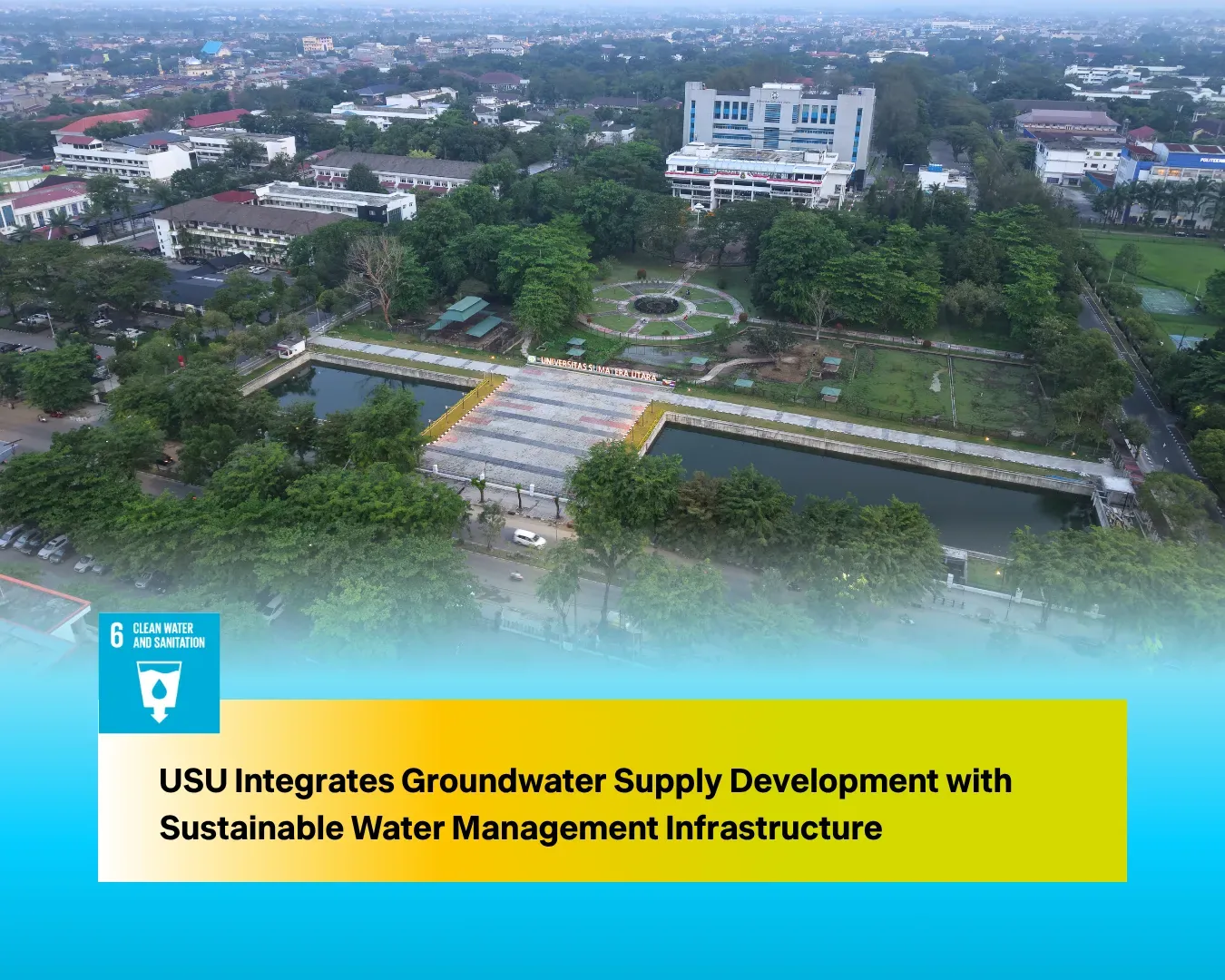
Medan, Indonesia — Universitas Sumatera Utara (USU) is strengthening the management of campus water resources by linking groundwater supply infrastructure with rainwater harvesting, infiltration facilities, consumption monitoring and environmental research. Its 2025 procurement records and Green Campus and UI GreenMetric documentation show how water provision is being addressed alongside measures designed to conserve freshwater resources.
Groundwater Infrastructure at the Faculty of Social and Political Sciences
USU’s 2025 public procurement register records a borehole construction contract for the Faculty of Social and Political Sciences (FISIP), dated 18 February 2025, awarded to CV Daf’al. A separate consultancy contract for construction supervision was registered on the same date. These records document university investment in groundwater supply infrastructure and technical supervision of the project.
The borehole is considered within USU’s wider approach to responsible water management, in which direct water supply is complemented by measures to manage water demand, protect infiltration areas and retain rainwater. The public contract register identifies the work but does not report commissioned pumping rates, groundwater-level readings or the operational withdrawal volume for 2025.
Water Storage and Resource Management at the Kwala Bekala Campus
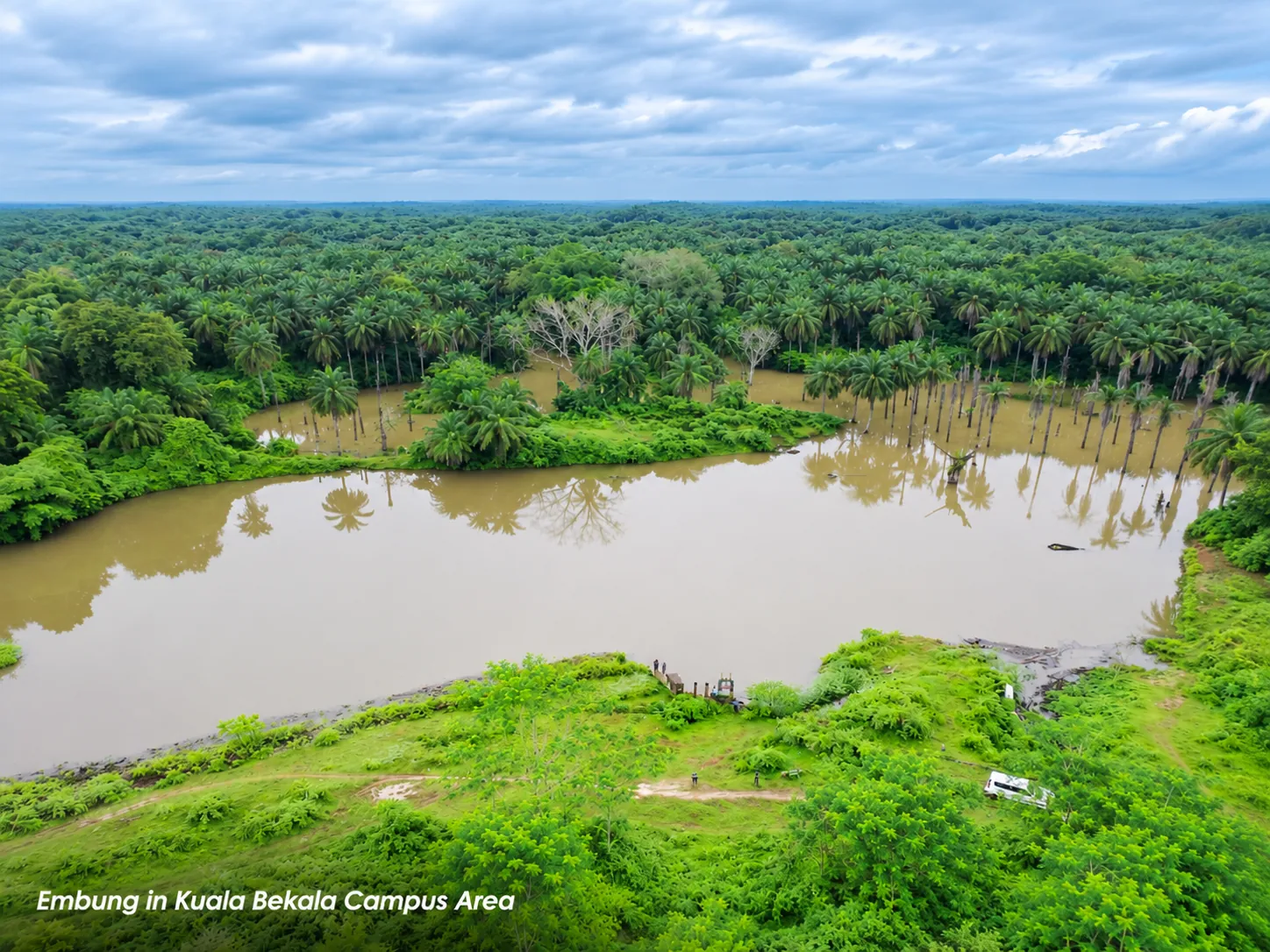
USU also maintains a large reservoir within its Kwala Bekala Campus area in Deli Serdang Regency, extending water-resource management beyond the main Padang Bulan campus. The university’s 2025 Green Campus and UI GreenMetric Report records the Kwala Bekala reservoir as covering approximately five hectares, with a reported water storage capacity of 500,000 cubic metres.
The reservoir forms part of USU’s wider approach to managing surface water and conserving available freshwater resources. Together with campus infiltration ponds and rainwater harvesting facilities, this infrastructure supports water storage, runoff management and long-term resource planning on university-associated land.
The reported 500,000 m³ is storage capacity, not a measured volume of water extracted or supplied. Documentation of water withdrawal and its operational controls would be needed to describe the reservoir as an active sustainable extraction system.
Conserving Water Resources Through Infiltration and Retention
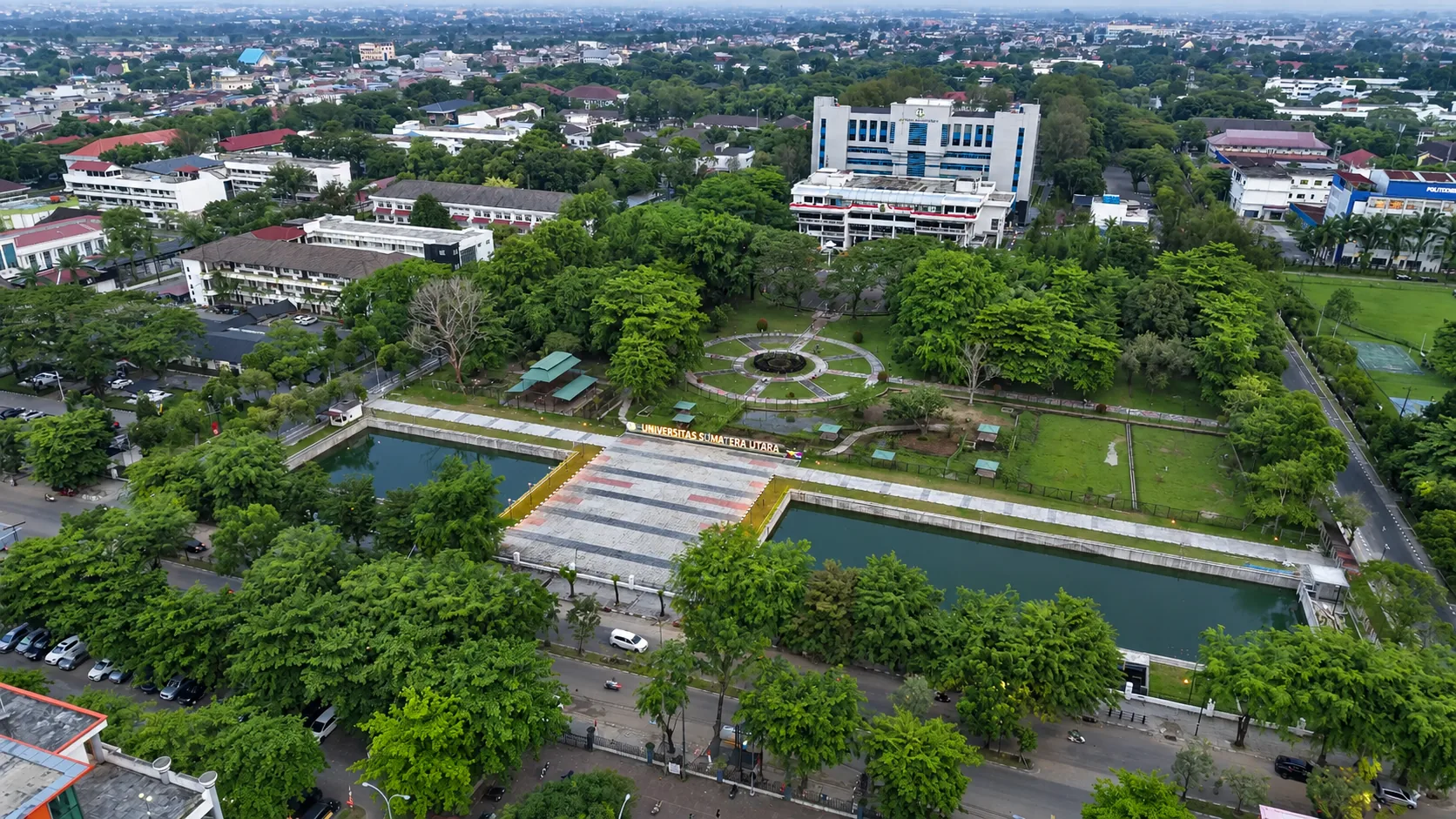
USU’s 2025 Green Campus and UI GreenMetric evidence documents a network of infiltration ponds, retention structures and reservoirs at university locations. These include infiltration facilities near the Central Library, Faculty of Agriculture, Faculty of Engineering, Faculty of Pharmacy and the Tri Dharma Education Forest, as well as water-retention infrastructure in the Tambunan A and Kwala Bekala areas.
The report identifies the Tambunan A infiltration pond as having an approximately 35,000 m³ storage volume. Such storage infrastructure supports stormwater management and conservation alongside measures to improve water-use efficiency.
Rainwater Harvesting Reduces Reliance on Conventional Water Supply
The same 2025 report documents rainwater harvesting at the Faculty of Engineering, Mini Stadium, Information Study Center and Central Administration area. The Faculty of Engineering system has a reported storage capacity of 2,000 litres, while the Mini Stadium installation has a reported capacity of 150,000 litres. Collected rainwater is used for suitable non-potable activities, including landscape watering and vehicle washing.
Using harvested rainwater for these applications complements groundwater resource protection by reducing the need to draw exclusively on piped water or other freshwater sources for routine campus activities.
Monitoring Water Demand and Managing Resources
Under the Water (WR) section of its 2025 UI GreenMetric documentation, USU describes a programme for water-use monitoring, conservation planning and evaluation supported by digital tools, including smart-meter and water-use analytics approaches. The report also records municipal water consumption of 549,059,525 litres from January to November 2025, equivalent to 549,059.525 m³ over eleven months.
These consumption figures provide a quantitative basis for managing institutional demand. They are distinct from a measurement of water abstracted by the FISIP borehole; separate well-level monitoring is required to establish the volume and sustainability of any groundwater withdrawal.
Exploring Water-Resource Research with Deltares
On 24 February 2025, USU met with the Netherlands-based water research institute Deltares to explore cooperation on groundwater and subsurface water management, flood mitigation, retention ponds and the reservoir in the USU Arboretum. The discussions, reported by USU on 25 February, provide an additional avenue for developing hydrological research and future practical solutions for campus and regional water management.
Toward Responsible Water Use on University Grounds
USU’s water infrastructure illustrates a connected resource-management approach: developing supply facilities where needed, retaining and harvesting rainwater, maintaining infiltration areas and documenting water consumption. The 2025 records establish investment in groundwater infrastructure and implementation of complementary conservation technologies across university sites.
The university’s ongoing sustainability efforts provide a foundation for linking groundwater facilities to operating procedures, groundwater-level monitoring and controlled abstraction, supporting the longer-term objective of sustainable water supply on its grounds.