


Medan, 28 November 2024 - The transition toward responsible consumption and production represents one of the most pressing global challenges addressed under Sustainable Development Goal 12 (SDG 12). Overconsumption, waste mismanagement, and inefficient production practices have placed enormous pressure on ecosystems and natural resources. In this context, Universitas Sumatera Utara has positioned itself as a key institutional actor in promoting sustainable transformation through research, education, and community engagement.
Universitas Sumatera Utara (USU) demonstrates a strong institutional commitment to SDG 12: Responsible Consumption and Production through comprehensive policies on waste management, hazardous material control, and plastic reduction. These initiatives reflect an integrated Green Campus strategy that emphasizes environmental responsibility, technological innovation, and behavioral change.
Hazardous Waste Management
Since 2019, USU has implemented a formal policy for managing hazardous and toxic waste (B3), ensuring environmentally sound and legally compliant practices across hospitals, laboratories, and research centers. The framework was reinforced by Rector’s Regulation No. 3 of 2019 on Green Campus Implementation, which aligns with national environmental standards. USU partners with PT Sumatra Deli Lestari Indah (PT SDLI) for hazardous waste collection and processing, and maintains dedicated temporary storage facilities equipped with cold chambers, sorting systems, and Material Safety Data Sheets (MSDS). In collaboration with Earthwise Consulting Japan, USU also explores innovative circular economy solutions, such as converting plastic waste into gasoline and diesel through pyrolysis technology.
.png)
Landfill Waste Reduction and Recycling
USU tracks the volume of waste generated and recycled, ensuring accountability and transparency in waste management. The university produces approximately 428 kg of inorganic waste daily, with significant portions of plastic, paper, and metal diverted from landfills through recycling and upcycling programs. Technologies such as pyrolysis for plastic conversion and Black Soldier Fly (BSF) systems for organic waste treatment have reduced landfill contributions and supported resource recovery. Segregated waste bins installed across the campus facilitate proper sorting and public participation in sustainable waste disposal.
.png)
Minimization of Disposable and Plastic Items
Guided by Rector’s Regulation No. 3 of 2019 on Green Campus Implementation, USU has institutionalized measures to minimize disposable and single-use plastic items. The policy mandates the application of the 3R principles (Reduce, Reuse, Recycle) across academic and administrative activities. Awareness campaigns, vendor compliance requirements, and educational programs encourage sustainable habits and reduce non-biodegradable waste. Pyrolysis technology and ongoing partnerships with industry further enhance USU’s waste reduction outcomes.
.png)
Through these integrated approaches—combining policy, technology, and community engagement—Universitas Sumatera Utara exemplifies responsible consumption and sustainable waste management, contributing meaningfully to SDG 12 and advancing its long-term vision of an environmentally conscious Green Campus.
Socialization of Waste Management Towards a Zero Waste Campus
The Socialization of Waste Management Towards Zero Waste initiative embodies USU’s commitment to embedding sustainability into the heart of academic life. This program is part of the university’s long-term roadmap to achieve carbon neutrality by 2029, as mandated by the Rector’s Circular Letter No. 1 of 2023. The initiative aims to establish a comprehensive waste management system that minimizes landfill dependency by focusing on waste reduction, segregation, recycling, and composting.
Under this program, waste bins are color-coded for effective segregation of organic, inorganic, and hazardous materials. Composting facilities convert organic waste into fertilizer for campus green spaces, while partnerships with recycling companies ensure that plastics, glass, and paper are reprocessed responsibly. Educational workshops and public campaigns reinforce the behavioral aspect of waste management, encouraging students and staff to become active contributors to the zero waste movement.
.png)
This initiative serves as a model of institutional sustainability for universities across Indonesia. It creates a new generation of environmentally conscious graduates who integrate sustainable thinking into professional and personal decision-making. Beyond the campus, the initiative fosters a ripple effect as students and staff transfer these practices into their local communities, supporting the broader goal of SDG 12.5, reducing waste generation through prevention, reduction, recycling, and reuse.
Student Action through Ecobrick Creation
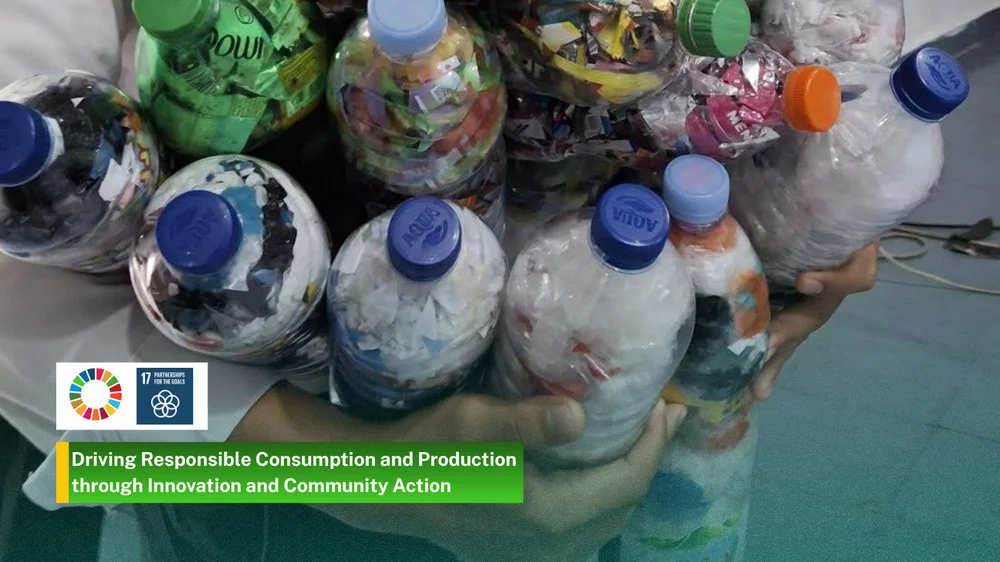
A compelling example of student-driven sustainability can be found in the Faculty of Engineering’s Ecobrick Project, where first-year students produced over one thousand ecobricks from non-recyclable plastic waste. The project integrates sustainability education with hands-on innovation, teaching students how to repurpose everyday waste materials into durable building blocks used for public infrastructure and community projects.
Students collected single-use plastics, cleaned and compressed them into plastic bottles, and assembled them into modular units. These ecobricks were later used in community projects, such as constructing seating benches and garden partitions in nearby schools and neighborhoods. Beyond its tangible environmental impact, the project emphasizes creative problem-solving and sustainability leadership among young engineers.
.jpg)
The ecobrick initiative contributes to both waste reduction and community empowerment. It engages youth in environmental problem-solving and provides low-cost construction materials for community use. By transforming plastic waste into practical infrastructure, the project advances SDG 12.8, which promotes education and awareness for sustainable lifestyles. It also embodies experiential learning, equipping students with the mindset and skills to innovate sustainably in their future professions.
Collaboration to Clean Up Mountain Area Waste
USU’s sustainability principles beyond the campus into natural conservation zones. In collaboration with local residents and tourism managers, USU students and faculty conducted a mountain clean-up campaign in North Sumatra’s highland regions, areas often impacted by tourism-related litter and agricultural waste.
.jpg)
The program combined environmental education with direct community involvement. Students analyzed waste composition, implemented waste segregation systems, and trained villagers on eco-friendly waste management methods such as composting and eco-enzymes. The project also promoted “carry-in carry-out” principles among tourists, encouraging them to take responsibility for their waste.
This initiative promotes the sustainable management of natural landscapes, contributing to SDG 12.4, which calls for the environmentally sound management of chemicals and waste throughout their life cycle. It reduces pollution, safeguards biodiversity, and nurtures environmental stewardship among both local communities and visitors. Moreover, it strengthens experiential education by allowing students to apply theoretical knowledge in real-world sustainability contexts.
Sustainable Agriculture through Superior Soybeans and Persimmon Cultivation
In the agricultural domain, USU’s research and outreach projects demonstrate how sustainable production systems can improve livelihoods and protect natural resources. Two notable examples include the Superior Soybeans with Three-way Cross initiative and the Persimmon Development Project in East Java.
The soybean research utilizes advanced genetic crossing techniques to produce high-yield, climate-resilient, and pest-resistant varieties. These new cultivars reduce the need for pesticides and fertilizers, minimizing environmental impact while increasing productivity and income for smallholder farmers. Meanwhile, the persimmon project trains farmers in post-harvest handling, product diversification, and marketing strategies to enhance competitiveness in domestic and export markets.
.jpg)
Both initiatives integrate sustainability principles, optimizing land use, conserving water, and promoting organic fertilization. Farmers are equipped with knowledge on sustainable agricultural practices, aligning productivity with environmental preservation.
These agricultural programs directly contribute to SDG 12.2, which emphasizes the sustainable management and efficient use of natural resources. They empower rural communities by improving food security, reducing production costs, and strengthening value chains. The initiatives also foster knowledge transfer between researchers and farmers, bridging the gap between academic science and practical agricultural innovation.
Waste Management for a Beautiful and Sustainable City
The research titled “Waste Management: Maintaining the Idea of a Beautiful Medan City” reflects USU’s contribution to urban sustainability and civic environmental governance. The study explores the design and implementation of urban waste management systems that combine infrastructure improvements with citizen engagement. It proposes models for optimizing waste collection routes, establishing neighborhood recycling stations, and implementing community-based monitoring mechanisms.
USU researchers worked alongside the Medan City Government and local NGOs to pilot these strategies in several districts. The findings highlight that effective waste management relies not only on technological solutions but also on the active participation of citizens in maintaining cleanliness and accountability.
.png)
This initiative strengthens the urban resilience and livability of Medan City, reducing pollution and enhancing public spaces. It supports both SDG 11.6 (reducing the environmental impact of cities) and SDG 12, by linking responsible consumption with sustainable urban governance. Furthermore, it builds public awareness that maintaining a clean city is a shared social responsibility that extends beyond government policies.
The diverse initiatives undertaken by Universitas Sumatera Utara under Sustainable Development Goal 12 (Responsible Consumption and Production) exemplify how higher education can serve as a hub for sustainability transformation. Through campus-wide zero waste programs, student innovations, environmental collaborations, sustainable agricultural research, and urban policy studies, USU integrates knowledge, practice, and community participation into a coherent sustainability framework.