


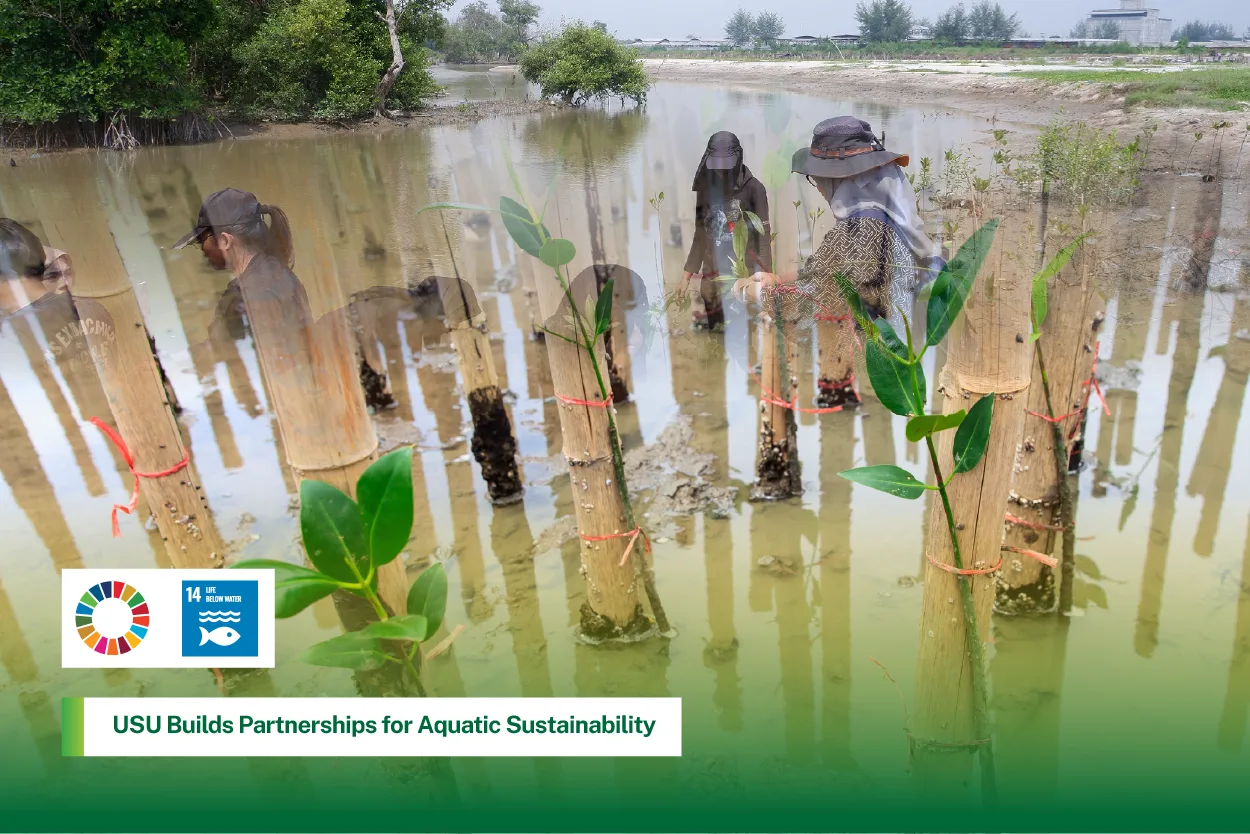
Medan, Indonesia (15 December 2024) – Universitas Sumatera Utara (USU) is strengthening its environmental role not only through research and teaching on campus, but also by working side by side with communities to protect rivers, lakes, and coastal ecosystems. By building long-term partnerships with local residents, governments, NGOs, and other stakeholders, USU links scientific knowledge with real action on the ground.
PUI Mangrove USU: community-led care for coasts and mangroves
A key example of this approach is PUI Mangrove USU (Center of Excellence for Mangrove), one of the university’s flagship programmes for coastal and mangrove stewardship. In 2024, USU allocated IDR 1.5 billion to support community‑driven conservation and restoration activities in North Sumatra’s mangrove and coastal areas.
.jpg)
With this support, local groups, students, and lecturers worked together to carry out:
educational workshops on sustainable coastal management and the role of mangroves for fisheries and shoreline protection;
mangrove replanting and rehabilitation, helping restore degraded shorelines and improve habitat for fish, crabs, and birds;
capacity-building sessions that strengthen local knowledge on sustainable resource use, including how to protect mangroves while maintaining fishing and livelihood activities.
.png)
PUI Mangrove Held Educational Workshop on Sustainable Coastal Management
In several sites, village organisations, youth groups, and women’s groups took the lead in planning and implementing activities, with USU teams providing scientific guidance and technical support. Some activities also welcomed participants from outside the region and international academic partners, helping to exchange experiences across different coastal contexts.
The result is an inclusive form of environmental stewardship in which communities are not just beneficiaries, but co‑managers of their own coastal ecosystems.
Working together in Lake Toba, Batang Toru, and the Leuser landscape
USU’s partnerships extend well beyond coastal areas. The university collaborates with local governments, civil society organisations, and community groups in several key aquatic landscapes, including:
Lake Toba, one of Indonesia’s most important lake ecosystems;
the Batang Toru watershed, which links upland forests to downstream rivers;
parts of the Leuser Ecosystem, where rivers, wetlands, and forests interact.
According to the 2024 LAKIP and Laptah reports, lecturers and students from various faculties carry out community service (pengabdian kepada masyarakat), environmental monitoring, and training programmes in these areas. Activities include:
involving local villagers and indigenous communities in habitat and water‑quality monitoring;
supporting biodiversity protection, such as documenting key species and promoting rules to reduce pressure on sensitive areas;
helping communities design ecotourism initiatives that showcase lakes, rivers, and forested watersheds while maintaining ecological limits;
delivering environmental education in schools and village halls, often using simple tools and demonstrations to explain the links between land use, water quality, and aquatic life.
.jpg)
These collaborations reflect the summary that “USU forms strong partnerships with local communities to protect aquatic environments through interdisciplinary approaches”. Scientific input from USU is combined with local and indigenous knowledge, so that conservation strategies are both technically sound and culturally appropriate.
International partnerships for better water and aquatic management
Alongside community partnerships, USU also builds international collaborations that strengthen water and aquatic sustainability.
With Deltares in the Netherlands, USU collaborates on environmental and water infrastructure research. This partnership supports joint studies on topics such as flood risk, river and coastal dynamics, and urban water systems, helping decision makers design infrastructure and policies that are more resilient and environmentally friendly.
.png)
USU and Deltares teams discuss collaborative research on environmental and water infrastructure, supporting joint studies on flood risk, river-coastal dynamics, and resilient urban water systems.
With Muroran Institute of Technology in Japan, USU conducts research on Solar Still technology as a way to address freshwater scarcity using seawater. This work explores how solar-powered distillation can provide clean drinking water for coastal or island communities while keeping energy use low and environmental impacts minimal.
.png)
These collaborations connect local challenges in North Sumatra with international expertise and innovation, and they involve researchers and students from Indonesia, the Netherlands, Japan, and other countries. Together, they demonstrate how global partnerships can produce practical solutions for water security and healthier aquatic ecosystems.
Inclusive conservation that supports local livelihoods
USU’s community‑centred work does more than protect fish, mangroves, and riverbanks. It also helps to:
strengthen local livelihoods, by encouraging sustainable tourism, small green businesses, and value‑added activities linked to healthy ecosystems;
open up opportunities for youth and community leaders to participate in environmental decision‑making;
create a shared understanding that protecting water and aquatic habitats is closely tied to long‑term economic and social well‑being.
By empowering local stakeholders, USU helps ensure that conservation is fair, participatory, and aligned with regional development goals, rather than imposed from outside.
From mangrove villages on the coast to communities around Lake Toba and the Batang Toru and Leuser landscapes, USU shows how a university can move from campus to community in very concrete ways. By combining science, local participation, and shared responsibility, USU helps protect vital aquatic ecosystems while building stronger, more resilient communities that depend on them.