


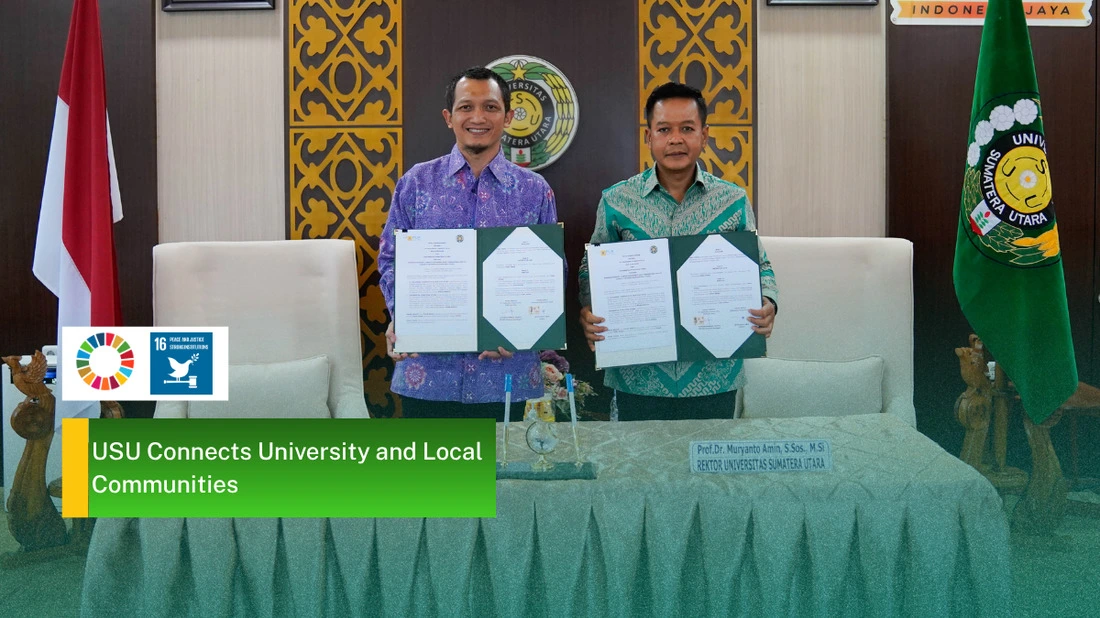
Medan, 2024 – Universitas Sumatera Utara (USU) has put in place a clear and structured system to make sure that every partnership with government, industry, communities, and international institutions is built on transparency, accountability, and shared benefit. This system connects academic freedom on campus with responsible engagement beyond the campus gates.
At the heart of this framework are three key regulations:
PerMWA USU No. 16 of 2016 on Organisation and Governance
Rector’s Regulation No. 4 of 2022 on the Implementation of Academic Cooperation
Rector’s Decree No. 1501/UN5.1.R/SK/KPM/2020 on Procedures for Academic Cooperation
Together, they guide how stakeholders are identified, how collaboration is approved, and how joint programmes are monitored over time.
Governance foundations: partnership as part of USU’s mandate
PerMWA USU No. 16 of 2016 defines the organisational and governance system of USU as a Perguruan Tinggi Negeri Badan Hukum (PTN‑BH). In this statute, collaboration is not treated as an add‑on, but as part of the university’s core mission in education, research, and pengabdian kepada masyarakat (community service).
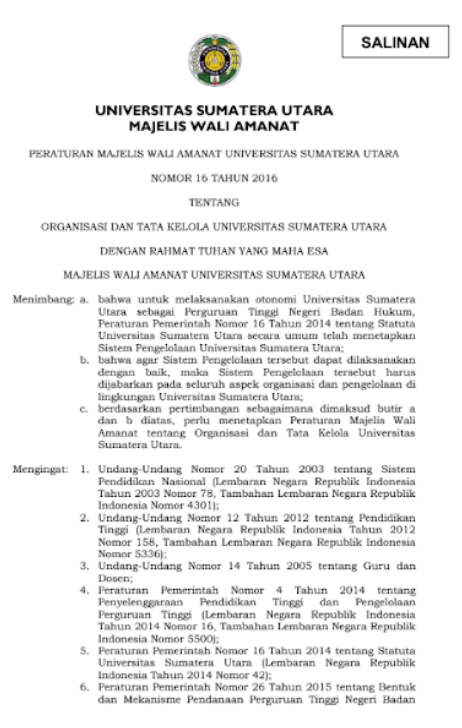
USU’s PerMWA No. 16 of 2016 on Organisation and Governance provides key procedures for identifying and engaging local external stakeholders in university activities.
Articles 20 and 21 instruct the university to encourage, facilitate, and develop partnerships with:
government institutions,
the private sector,
alumni, and
communities, both in Indonesia and overseas.
These provisions ensure that cooperation is aligned with USU’s long‑term strategy and its community‑oriented mission, and that community service is carried out through structured, accountable, and sustainable partnerships.
Operational rules: who USU works with and how
Rector’s Regulation No. 4 of 2022 translates these governance principles into day‑to‑day practice. It defines cooperation as a legal relationship between USU and external partners based on mutual benefit, covering:
education and training,
research and innovation, and
public‑service and community programmes.
![]()
Rector’s Regulation No. 4 of 2022 operationalizes USU’s governance principles by defining collaboration with external partners and guiding the identification and engagement of local stakeholders.
The regulation clearly sets out categories of partners, including:
schools and higher‑education institutions,
ministries and local governments,
NGOs and community organisations,
companies, start‑ups, and industry associations, and
regional and international organisations.
All proposals for cooperation are channelled through the Bureau for Research, Community Service, and Cooperation (BPPM USU) and recorded in the university’s digital system SIMKERMA (simkerma.usu.ac.id). This centralisation allows USU to track who it works with, what has been agreed, and how each collaboration contributes to its strategic goals.
Letters of Intent (LoI), Memoranda of Understanding (MoU), and Memoranda of Agreement (MoA) follow standard formats and are reviewed to ensure that benefits, responsibilities, and intellectual‑property issues are clearly defined.
Technical procedures: mapping, approval, and monitoring
Rector’s Decree No. 1501/UN5.1.R/SK/KPM/2020 provides the technical SOPs for identifying local external stakeholders and engaging with them in USU’s collaboration activities.
Rector’s Decree No. 1501/UN5.1.R/SK/KPM/2020 provides the technical Standard Operating Procedures (SOPs) that complement the 2022 regulation. The decree:
lists specific stakeholder categories such as ministries, provincial and municipal governments, community organisations, research institutes, and local enterprises;
sets step‑by‑step procedures for initiating, implementing, and monitoring collaboration;
requires every cooperation project to go through a formal approval process and to be recorded in institutional documents;
regulates financial and non‑financial contributions so they comply with ethical, legal, and administrative standards.
These SOPs ensure that each partnership is traceable, auditable, and measurable, rather than informal or ad hoc.
USU’s strategic plan also sets an internal target to increase the number of collaborative projects by around 20 percent each year, especially with government, industry, and international partners. This growth is pursued within the boundaries of the governance and ethics framework, so that expansion never comes at the expense of quality or integrity.
Academic freedom and research integrity at the core
While USU actively encourages collaboration, it also protects the academic freedom and scientific autonomy of its scholars.
The Academic Senate Regulation No. 01 of 2017 (updated in 2022) guarantees that academics:
can select their research topics,
are free to express and defend academic opinions, and
have the right to publish and disseminate their findings.
The 2022 update strengthens links between academic freedom, research integrity, and quality assurance, ensuring that cooperation with external stakeholders does not compromise ethical standards or scientific independence.
These principles are supported by the Rector’s Decree on Research Ethics and the Guidelines for Research and Community Service, which set boundaries for conflicts of interest, responsible data use, and engagement with communities and industries.
In practice, this means that while USU has clear mechanisms for mapping, approving, and monitoring partnerships, the content and direction of research remain in the hands of the academic community, guided by ethics and scientific merit.
Structured collaboration for just and effective institution
.jpg)
By bringing together governance rules, operational guidelines, technical SOPs, and protections for academic freedom, USU has built a coherent collaboration ecosystem. Every joint activity, from small community projects to large national or international research partnerships, operates within a framework that is:
structured,
transparent, and
accountable.