


Medan, Indonesia, 13 September 2024 — Universitas Sumatera Utara (USU) continues to reinforce its role in promoting sustainable water management through education, research, and community engagement. In line with Sustainable Development Goal (SDG) 6: Clean Water and Sanitation, USU integrates water and environmental topics into its academic programmes and community service activities so that knowledge and skills are shared not only with students but also with the wider public.
Formal and informal education on water management
Based on USU’s sustainability reporting and curriculum documentation, the university offers a wide range of courses that address sustainable water use, pollution control, and sanitation infrastructure. These are delivered by faculties in environmental engineering, natural sciences, and public health.
Key subjects include, among others:
- Water Quality Analysis and Monitoring
- Drinking Water Treatment Plant Design
- Wastewater Treatment Planning
- Environmental Remediation of Soil and Water
- Tourism and Sanitation Infrastructure
Through these courses, students gain both technical knowledge and practical skills to respond to real‑world water and environmental challenges. Many programmes include laboratory work, field projects, and collaboration with local institutions, ensuring that academic learning is closely connected to practical solutions on the ground.
.webp)
Community‑based education and public engagement
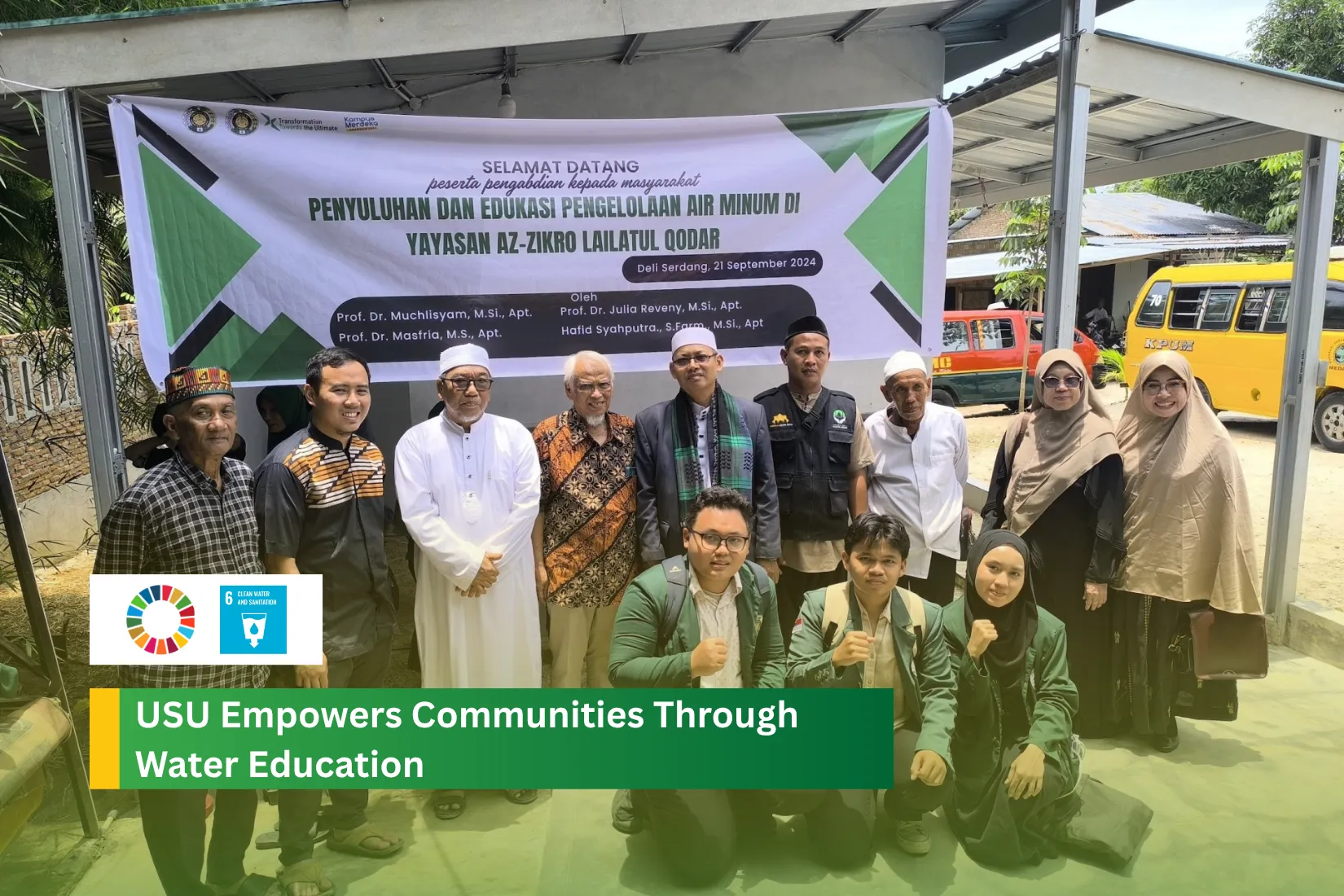
Beyond formal teaching, USU actively promotes informal learning and public awareness through community workshops, seminars, and outreach programmes. The Community Service Institution (LPPM USU) plays a central role in coordinating these initiatives, which are designed to increase public understanding of water conservation, pollution prevention, and safe sanitation practices.
These activities are often led by lecturers from the Faculty of Engineering and the Faculty of Public Health, together with student volunteer groups under the KKN Tematik (Community Service Programme), and are conducted in partnership with local government agencies and environmental bodies.
Examples include public lectures on efficient water use, training on small‑scale wastewater treatment for local businesses, and joint campaigns to keep rivers clean and promote safe drinking water practices in rural and peri‑urban communities.
.webp)
Building local capacity and strengthening sustainability impact
Through consistent engagement and inclusive learning approaches, USU’s water‑related education programmes help build local capacity for effective water resource management. Communities are encouraged and supported to adopt sustainable practices in their own neighbourhoods, whether by improving household sanitation, reducing pollution, or managing local water sources more wisely.
Commitment to the Sustainable Development Goals
These integrated academic and community training efforts reaffirm USU’s commitment to SDG 6 (Clean Water and Sanitation) and SDG 4 (Quality Education), and are closely aligned with Rector’s Regulation No. 3 of 2019 on the Implementation of the Green Campus Movement.
By linking classroom learning with community empowerment, Universitas Sumatera Utara is helping to build a culture of environmental stewardship and sustainable water use, ensuring that its positive impact extends well beyond the physical boundaries of the campus.
.webp)