


.webp)
Medan, Indonesia, 15 September 2024 — Universitas Sumatera Utara (USU) has reinforced its commitment to sustainable resource management by developing a comprehensive and efficient water supply system that supports academic, research, and community service activities under the Tridharma of Higher Education.
USU’s main source of clean water is PDAM Tirta Nadi, the regional drinking water company of Medan, which supplies treated water through a centralized piped network across the campus. All consumption is measured systematically using official PDAM billing records, creating an accurate and traceable database for monthly and annual analysis. This allows USU to maintain a transparent, data-driven approach to monitoring and managing its water resources.
Alongside the PDAM supply, USU has introduced a range of sustainable and alternative water sources to reduce dependency on external providers. Rainwater harvesting systems have been installed at several facilities, such as the Faculty of Engineering, the Information Study Centre, and the USU Mini Stadium, where collected rainwater is stored for non-potable uses. The Digital Learning Center Building also operates a wastewater recycling system, in which greywater is treated and reused for toilet flushing and landscape irrigation. This system reflects USU’s commitment to circular water management.
To support water conservation and groundwater recharge, USU manages a network of retention ponds, infiltration wells, bio-pores, and reservoirs, particularly at the Kuala Bekala and Tambunan A campuses. These structures help control surface runoff, reduce the risk of flooding, and contribute to maintaining groundwater balance and long-term ecosystem resilience.
Commitment to Water Efficiency and Pollution Control
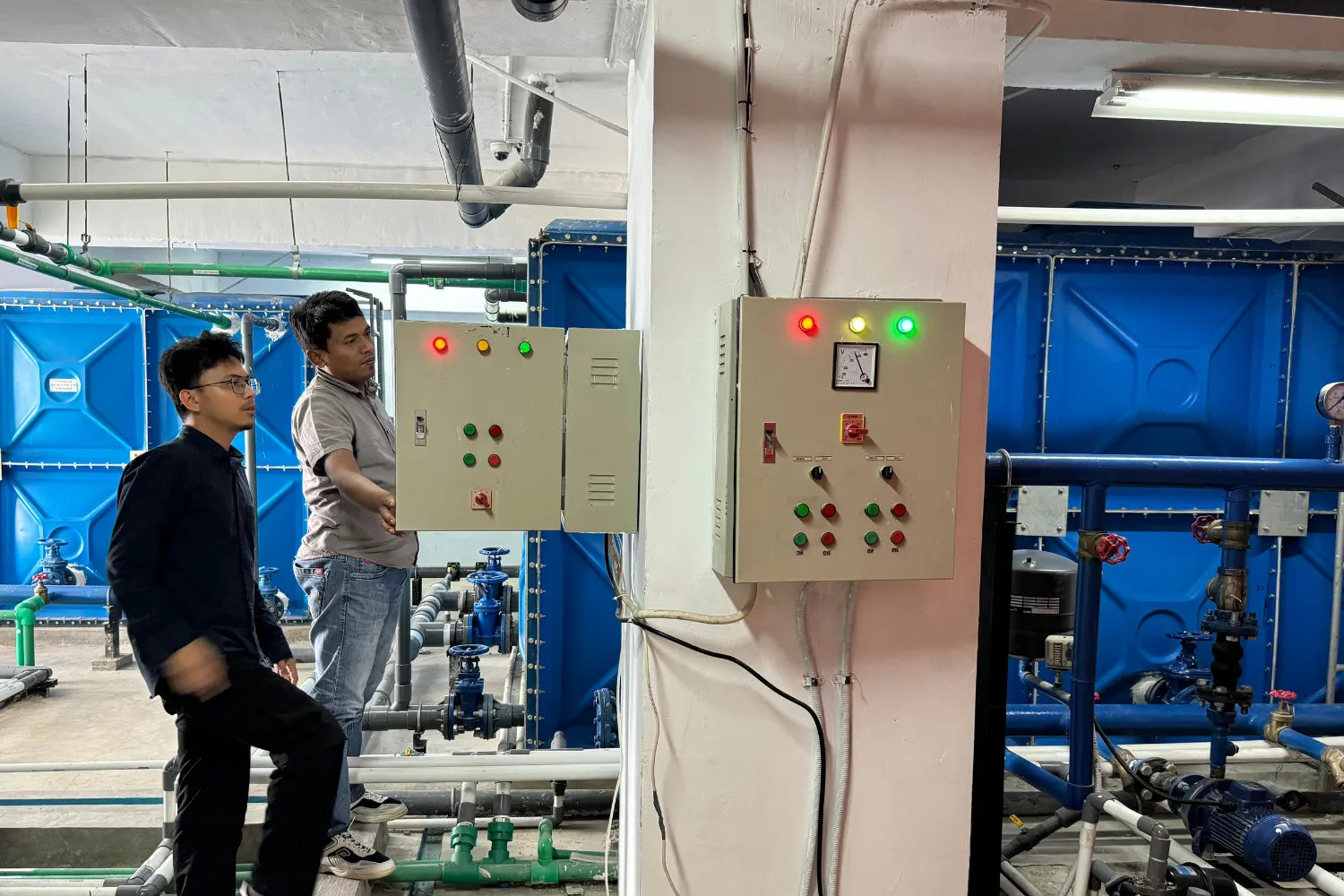
Beyond securing water supply, USU places equal emphasis on wastewater treatment before it is released back into the environment. The university operates decentralized wastewater treatment plants (WWTPs) to prevent pollution and protect surrounding ecosystems. In parallel, sensor-based faucets, automatic irrigation systems, and a proactive leak-repair programme have been implemented to minimise unnecessary water loss.
Campus-wide awareness campaigns also play an important role. Through posters, seminars, and student activities, USU encourages behavioural change among students, lecturers, and staff, making water conservation a shared responsibility across the academic community.

Data-Driven Monitoring and Continuous Improvement
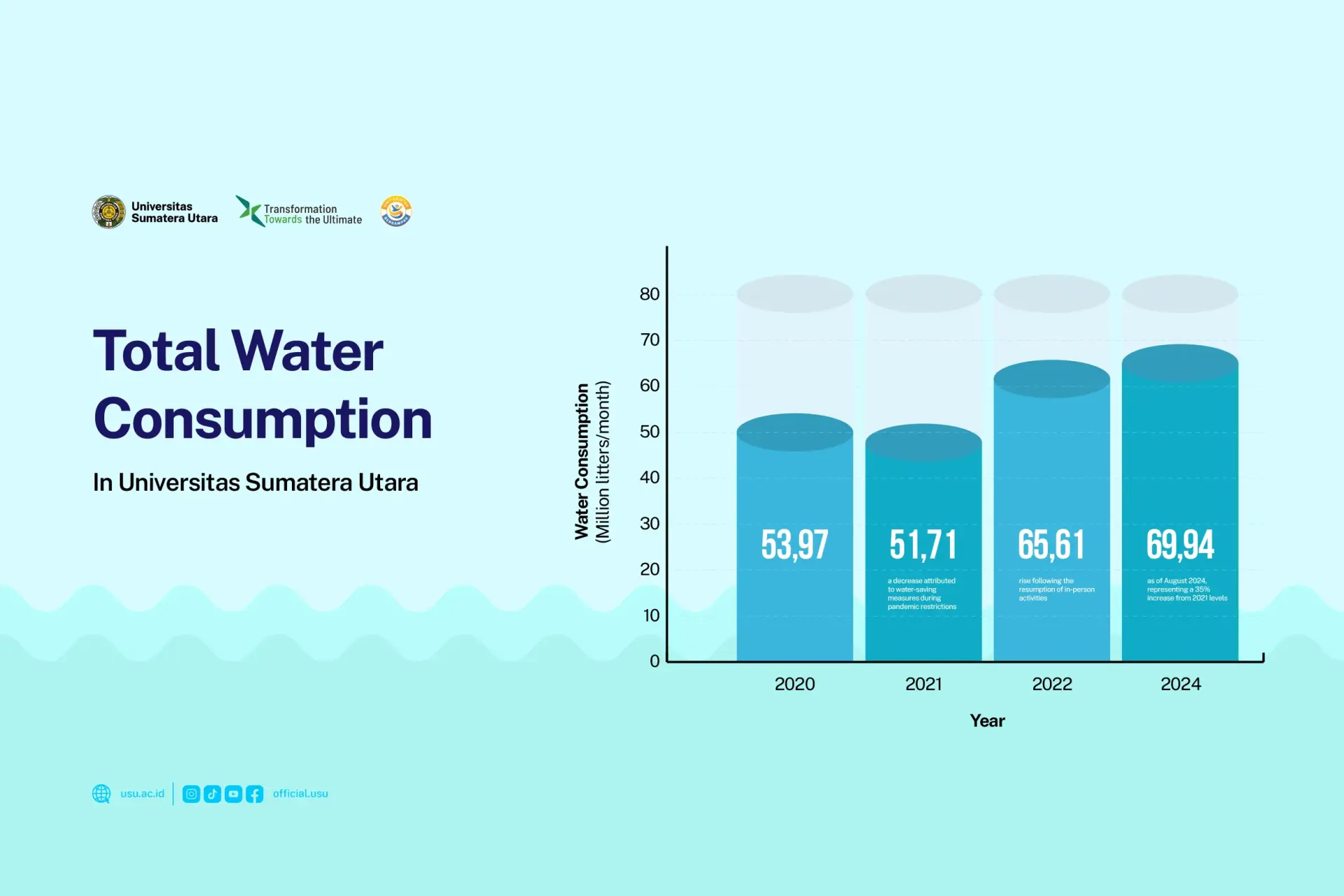
According to the UI GreenMetric 2024 Report, USU continues to measure and report total water consumption as part of its environmental performance assessment. The data show a clear pattern of consumption management:
- 2020: 53.97 million litres per month
- 2021: 51.71 million litres per month (a decrease linked to water-saving measures during pandemic restrictions)
- 2022: 65.61 million litres per month (an increase following the return of in-person activities)
- 2024: 69.94 million litres per month (as of August 2024, representing a 35% increase from 2021 levels)
Although detailed breakdowns by source (for example, municipal supply, groundwater, or harvested rainwater) are not yet published, USU’s expanding infrastructure and monitoring systems indicate a steadily evolving strategy for sustainable water management.
Towards a Sustainable and Resilient Campus
Through continuous infrastructure development, the use of appropriate technologies, and the active involvement of its academic community, USU demonstrates institutional leadership in responsible water management. The university’s integrated approach, which combines conservation, reuse, and data-based monitoring, aligns with Sustainable Development Goal (SDG) 6: Clean Water and Sanitation and helps ensure that water is managed as a renewable and sustainable resource within the campus ecosystem.