


Medan, 23 December 2024 – Universitas Sumatera Utara (USU) runs a range of international and local outreach programmes that help coastal and rural communities manage fisheries, aquaculture, and tourism more sustainably. Through education, training, and community service, the university links ecosystem conservation with livelihood development for communities in North Sumatra and beyond.
Cross-border programmes for sustainable livelihoods
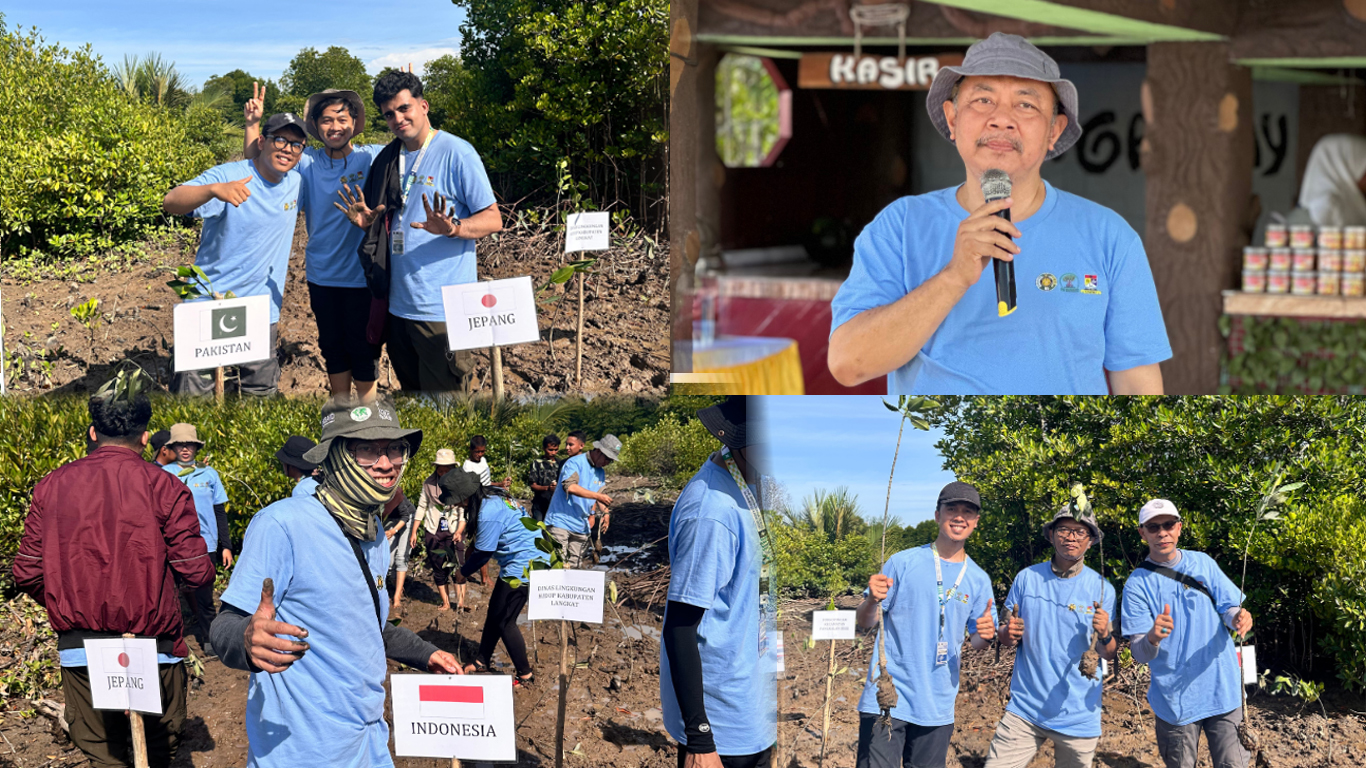
Picture: USU’s Faculty of Forestry conducts an international community service program through mangrove planting at Beras Basah, empowering coastal communities with sustainable fisheries and tourism education.
In 2024, USU carried out an International Community Service (Abdimas Internasional) programme in collaboration with Malaysian universities Universiti Teknologi MARA (UiTM) and Universiti Putra Malaysia (UPM). The initiative was led by the Faculty of Forestry, the Postgraduate School, and the Faculty of Agriculture, and involved 50 USU students and 25 academic staff working alongside community members.
Activities took place in the buffer zone of Gunung Leuser National Park (TNGL) and surrounding rural areas in Langkat Regency. While the main technical focus was bamboo conservation as a sustainable land and resource management model, the programme also introduced:
Training on eco‑tourism development (guiding, homestays, nature‑based attractions),
Education on land‑based aquaculture as an alternative income source that reduces pressure on wild fish stocks,
Community discussions on how to link conservation efforts with tourism and small‑scale fisheries.
The programme combined classroom-style sessions with field demonstrations, allowing local residents to learn how sustainable tourism and aquaculture can support family incomes while maintaining forest and river health.
Education for coastal and near‑coastal communities
USU’s outreach is not confined to upland zones. The university also works with coastal and near‑coastal communities in North Sumatra to promote sustainable management of fisheries and tourism. Through community service projects coordinated by the Institute for Community Service USU, lecturers and students deliver:
Workshops on responsible small‑scale fisheries and aquaculture,
Training on eco‑tourism planning, including visitor management, basic hospitality, and waste reduction at tourist sites,
Environmental education sessions for local schools, youth groups, and community leaders.
.png)
.png)
USU team visits and introduces clean marine energy through solar panel installation in Sibolga, supporting coastal community empowerment in sustainable fisheries and tourism.
These programmes help communities understand the links between healthy mangroves, clean rivers and seas, and long‑term economic opportunities. Participants learn practical steps such as limiting destructive fishing practices, protecting nursery habitats, improving sanitation in coastal villages, and designing tourism activities that respect local ecosystems.
Community-based natural resource management
A core feature of USU’s approach is community-based natural resource management. Rather than imposing solutions from outside, the university works with grassroots organisations, village groups, and local government to co‑design activities.
Communities are involved in:
Identifying local environmental problems that affect fisheries and tourism,
Agreeing on rules for sustainable resource use,
Developing simple monitoring systems for rivers, forests, and coastal areas.
Through these participatory methods, USU’s programmes strengthen local capacity to manage fisheries, aquaculture ponds, river corridors, and tourism sites in ways that support both environmental protection and income generation.
Linking ecosystems and livelihoods
Across its international and local outreach work, USU emphasises that forests, rivers, and coasts form one connected system. Sustainable bamboo management and land‑based aquaculture upstream help protect water quality and habitats downstream, which in turn support coastal fisheries and tourism.
By offering structured educational programmes and hands‑on outreach on sustainable fisheries, aquaculture, and tourism, Universitas Sumatera Utara shows how a university can act as an institutional driver of change, helping local and national communities build livelihoods that are closely aligned with the long‑term health of both terrestrial and marine ecosystems.