


.webp)
Medan, (June 18, 2024) — Universitas Sumatera Utara (USU) is strengthening its role in North Sumatra’s energy transition by helping communities build practical skills in energy efficiency and clean energy. Through recurring community programmes, student community service, and outreach led by the USU SDGs Center, the university is turning abstract concepts such as “renewables” and “low‑carbon futures” into hands‑on learning and real benefits for households and villages.
USU’s efforts are anchored in Rector’s Circular Letter No. 1 of 2023 on Environmental Management and Carbon Neutrality by 2029, which calls on the university not only to decarbonise its own operations, but also to share knowledge and tools with surrounding communities. Under this mandate, energy‑related activities are integrated into community service schemes (PKM/KKNT) and SDGs‑focused outreach. The objective is clear: equip local communities, especially youth and village leaders, with the skills and confidence to use energy more efficiently and to adopt small‑scale renewable solutions.
.webp)
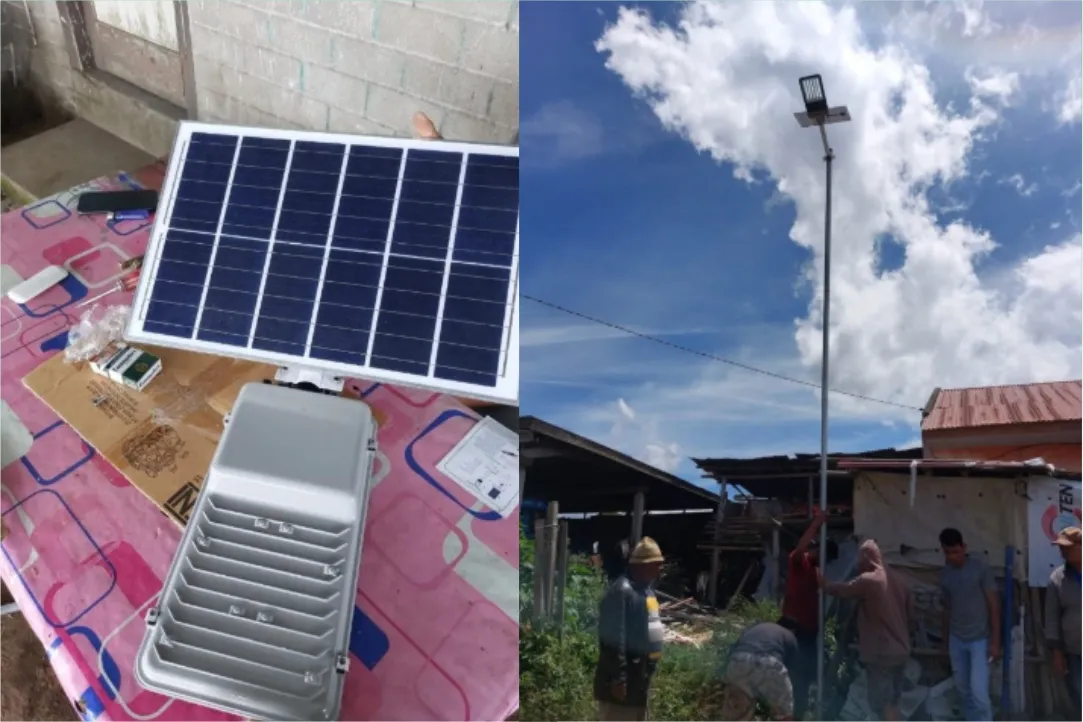
A core feature of USU’s approach is energy‑focused community education. In Desa Lingga, Karo, lecturers and students conduct solar PV street‑lighting training and installation, working with villagers to install and maintain solar streetlights. The sessions introduce basic PV operation, routine maintenance, and the benefits of efficient public lighting—improving safety while reducing electricity costs and dependence on diesel‑based systems. The solar units become both infrastructure and classroom, giving communities a tangible entry point into clean‑energy technology.
In Tadukan Raga, Deli Serdang, USU teams facilitate household‑scale biogas training that integrates palm‑oil mill effluent and empty fruit bunches to produce clean cooking fuel. Through demonstrations and guided practice, local households learn how to feed digesters, manage gas output, and use biogas safely in daily cooking. The initiative reduces reliance on firewood and LPG, cuts smoke exposure in the home, and turns agricultural by‑products into a useful energy resource.
.webp)
USU also supports pico‑hydro development and knowledge transfer in Desa Payung, where small‑scale renewable electricity is introduced to support rural productivity. Community workshops cover site selection, basic hydropower principles, and simple maintenance, allowing farmers and village technicians to understand not just how to operate the system, but why it works. The result is a shared sense of ownership over the technology and a clearer picture of how local water resources can be used sustainably.
.webp)
Beyond village‑level installations, the university runs seminars, workshops, and educational materials on energy and climate that are implemented with communities at local, regional, and national levels. These sessions address topics such as household energy conservation, efficient appliance use, safe and sustainable cooking fuels, and the links between energy, climate change, and livelihoods. Materials developed by the USU SDGs Center help standardise messages while allowing adaptation to local contexts and languages.
The scale and continuity of these efforts are notable. USU reports more than 10 sustainability‑related community service projects each year, with 122 such projects recorded in 2024 alone. Many of these initiatives incorporate SDG 7 (Affordable and Clean Energy) topics and mandate student involvement, ensuring that learning is firmly embedded in practice. Students from engineering, social sciences, public health, and other faculties work side‑by‑side with local partners, gaining exposure to real‑world challenges while contributing to solutions that communities themselves have helped design.
.webp)
On campus, these community programmes are reinforced by USU’s own clean‑energy and efficiency initiatives—such as smart‑building systems, rooftop solar, and passive‑design buildings—which serve as demonstration sites when community groups visit Medan. In this way, knowledge flows in both directions: communities see how a large institution manages energy, and USU researchers and students gain insights into the constraints and opportunities that shape energy choices in rural and peri‑urban areas.
Taken together, Universitas Sumatera Utara’s recurring programmes on energy efficiency and clean energy awareness show how a university can act as both an educator and a partner in the transition to low‑carbon development. By combining PKM/KKNT community service, USU SDGs Center outreach, and long‑term engagement with villages such as Lingga, Tadukan Raga, and Payung, USU ensures that progress toward its 2029 carbon‑neutrality target is not confined within campus boundaries, but shared with the communities it serves.
.webp)