


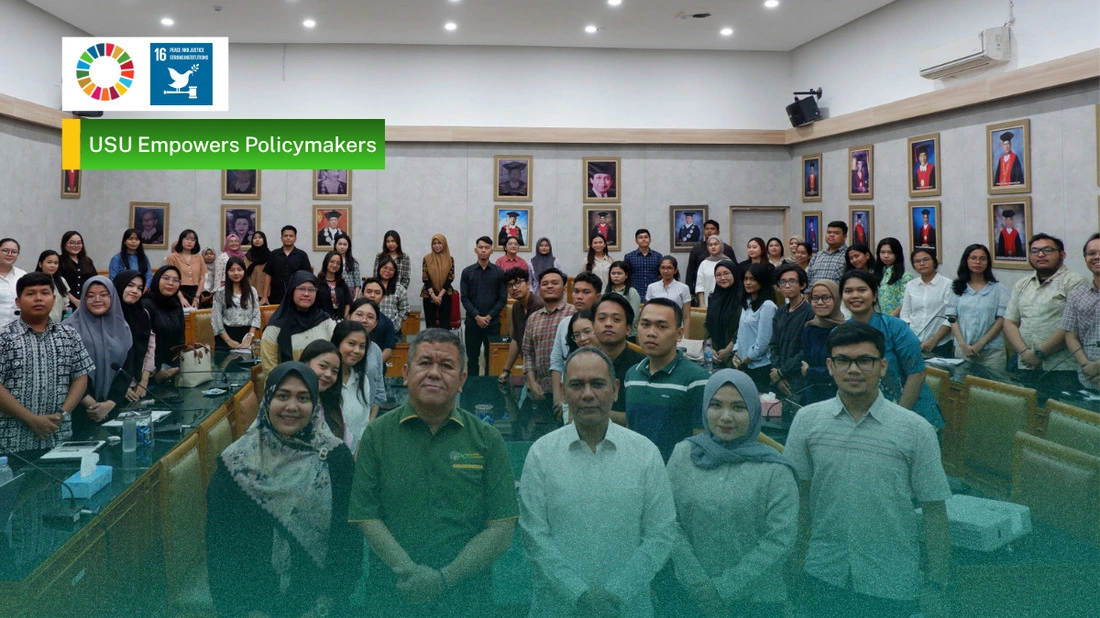
Medan, 2024 — Universitas Sumatera Utara (USU) is strengthening its role in governance reform and evidence‑based policymaking by running a wide range of outreach, training, and capacity‑building programmes for policymakers, government officials, lawmakers, and academic professionals.
These initiatives reflect USU’s mandate under the The Three Pillars of Higher Education (Education, Research, and Community Service) and its commitment to SDG 16: Peace, Justice and Strong Institutions, ensuring that public decisions are informed by research, professional skills, and ethical standards.
Training platforms across faculties and LPPM USU
.png)
Through key faculties (Law, Economics and Business, Social and Political Sciences, and Engineering) USU regularly organises programmes that combine theory, practical exercises, and professional skill development.
These activities are coordinated and supported by the Institute for Research and Community Service (LPPM USU), which works with ministries, regional governments, civil society organisations, and international partners to align each programme with real policy needs. Topics covered include economic transformation, legal reform, digital governance, environmental governance, and climate resilience.
Strengthening legal reasoning and policy skills
The Faculty of Law (FH USU) plays a central role in building legal and analytical capacity among future and current professionals.
.png)
Training Series on Case Analysis, Legal Reasoning, and Legal Skills
Organised by the Legal Aid and Consultation Bureau (LKBH FH USU), this series focuses on strengthening participants’ ability to analyse cases, construct legal arguments, and apply legal principles in practice.
Held in the Faculty’s Council Room, the training features lecturers and practitioners such as Devi Yulida, S.H., M.H., and is designed for students, young lawyers, and professionals who support law‑making and law enforcement.
.png)
Workshop on Legal Opinion Writing and Contract Drafting
The Master of Business Law (MIH) programme hosts workshops on drafting legal opinions and professional contracts.
These sessions bridge academic knowledge with real‑world practice, helping participants produce documents that are not only legally sound but also support transparent and accountable public and private sector governance.
Through these activities, FH USU helps equip the next generation of lawyers, legal drafters, and policy advisers with the skills needed to support fair and effective regulation.
Building internal academic leadership and governance capacity
USU’s capacity‑building efforts are not limited to students and external partners. The university also invests in the professional development of its own academic staff.
.png)
Basic Training for Permanent Lecturers – Batch II (2024)
Coordinated by the Human Resource Development Bureau (Biro SDM USU), this programme introduces newly appointed lecturers to academic ethics, innovative teaching methods, research leadership, and community‑engagement strategies.
The training encourages lecturers to act as agents of change—using research and teaching to support evidence‑based governance in their fields, and to collaborate with government and communities on policy issues.
Policy simulations and decision‑making support
In line with the summary you provided, LPPM USU and various research centres organise:
Workshops on evidence‑based decision‑making.
Policy simulation sessions for regional development planning, and
Forums on environmental governance and climate resilience.
These programmes are designed for officials from local and provincial governments, line ministries, and related agencies. Participants practise how to interpret data, evaluate policy trade‑offs, and design programmes that are both effective and accountable.
USU’s academics have, for example, supported capacity‑building activities with institutions such as the Ministry of Law and Human Rights, Ministry of Finance, and Ministry of Environment and Forestry, delivering training on regulatory analysis, fiscal governance, and environmental policy instruments.
In cooperation with the Provincial Government of North Sumatra, USU also facilitates leadership and planning workshops for local agencies, focusing on sustainable development, green economic transition, and digital governance.
Centres and institutes supporting legal and governance reform
Beyond faculty‑based initiatives, specialised units at USU provide structured support for governance improvement:
The Center for Legal Studies and Policy Reform offers continuing education, legal drafting support, and advisory services for government institutions, law enforcement agencies, and legislative bodies.
LPPM coordinates multi‑year programmes that link community service, policy research, and training, so that lessons from the field feed back into policy design and revision.
These efforts ensure that policymaking is not treated as a one‑off event, but as a continuous learning process informed by ongoing research and feedback.
Advancing SDG 16 through capacity‑building
Through its outreach, training, and advisory work, Universitas Sumatera Utara puts into practice exactly what your summary describes:
USU actively conducts outreach, general education, and capacity‑building for policymakers and officials at local, regional, and national levels;
programmes are delivered by multiple faculties and coordinated by LPPM USU in collaboration with ministries, local governments, and civil society;
the focus is on evidence‑based governance, ethical leadership, and sustainable development.
By fostering closer collaboration between academia and government, USU helps ensure that public decisions are based on data, guided by ethics, and responsive to societal needs.
In doing so, the university not only contributes to policy innovation and institutional efficiency, but also strengthens peace, justice, and strong institutions, in line with SDG 16 and Indonesia’s broader governance reform agenda.