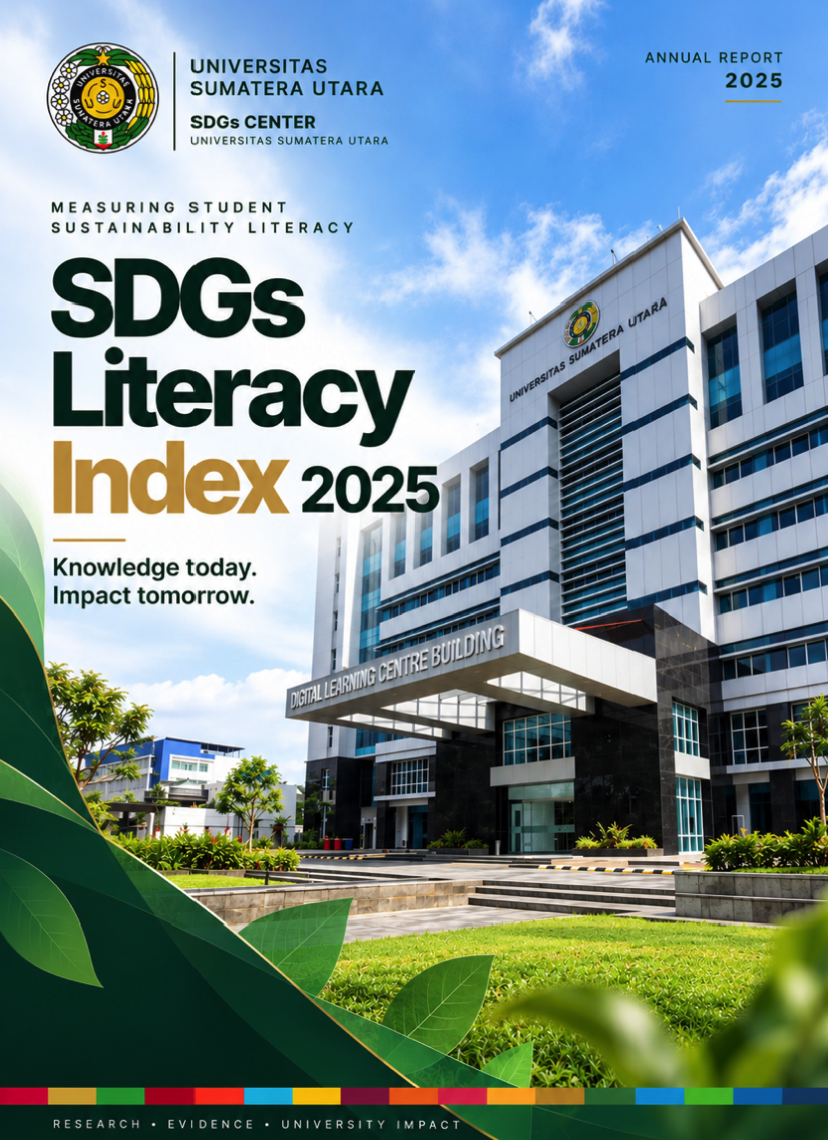
MEDAN, Indonesia - Universitas Sumatera Utara (USU) has broadened its measurement of student literacy in the Sustainable Development Goals (SDGs), supported by sustainability teaching, campus learning programmes and community activities documented during 2025. A review covering 353 student records from 14 faculties assessed conceptual understanding, knowledge of the individual SDGs, analytical reasoning and recognition of sustainable actions.
The subsequent scoring review reports an equally weighted four-domain index of 0.8586 and a separately calculated administrative score of 0.8601. Analytical skills recorded 0.8913, followed by knowledge of sustainable actions (0.8900), conceptual understanding (0.8320) and specific SDG knowledge (0.8211). On the administrative scoring scale, 341 students (96.6%) were classified Very High and another seven (2.0%) High, giving 348 students (98.6%) across the two highest categories. The behavioural questions assess recognition of suitable actions, not verified daily practice.
The university’s first published SDG literacy assessment in October 2024 covered 42 candidates in the SDGs Ambassador programme and recorded an index of 0.82. The wider subsequent dataset represents a major expansion in reporting coverage. However, the later scoring workbook carries October 2026 response timestamps and applies a different denominator; therefore, the numerical difference between 0.82 and 0.8586 must not be interpreted as a proven increase in literacy caused by university programmes.
Coursework Creates Repeated Exposure to Sustainability Concepts
The university’s Sustainability Report 2025 records 613 courses and modules covering sustainability and/or biodiversity. The subjects span environmental management, forestry, agriculture, public health, engineering, economic development and governance. This breadth allows students to encounter sustainability questions within their own disciplines, rather than treating the SDGs solely as an extracurricular campaign.
In September 2025, the Faculty of Forestry began five English-medium international classes that included Forest Management, Urban Forestry, In-situ and Ex-situ Conservation Techniques and Human–Wildlife Conflict Management. Other 2025 teaching linked national and global policy to professional practice: Leuser Conservation Partnership practitioners taught FOLU Net Sink 2030, timber legality and forest governance , while a Public Sector Accounting webinar introduced ESG principles and their relevance to responsible careers. These are documented opportunities for learning, although course participation among literacy survey respondents was not individually tracked.
SDG Forums Connect Foundational Knowledge with Campus Awareness
On 18–19 February 2025, USU held a two-day SDG awareness programme at its Digital Learning Center . Lecturers joined the first day and students the second. Speakers introduced systems thinking, SDG indicators, campus programmes and the university’s contributions to the goals. Such activities make the SDGs visible across faculties and give students a shared framework for interpreting environmental, social and economic challenges.
A separate 2025 sustainability-literacy study of 150 lecturers, education staff and students found that foundational knowledge and awareness of institutional sustainability initiatives were both associated with student literacy. This supports a strategy combining classroom learning with familiarity with campus programmes. The 150-person study is separate from the 353-response index assessment and does not establish that any particular activity caused a measured change in scores.
Living Laboratories and Fieldwork Link Knowledge to Decisions
The campus itself provides applied learning settings. On 6 May 2025, USU and the North Sumatra Provincial Government inaugurated an integrated waste processing site operated by the USU Circularity Center . The facility supports research involving five faculties and demonstrates organic-waste treatment, resource recovery and circular-economy applications. The Sustainability Report 2025 also documents waste-management facilities, sustainable-resource teaching and environmental rehabilitation initiatives
Outside campus, more than 100 Forestry students undertook a ten-day ecosystem field programme at Pondok Buluh in June 2025, covering vegetation, wildlife and environmental-service inventories. In September, an international mangrove restoration activity in Beras Basah brought together students, lecturers and residents for planting and conservation education. These experiences give sustainability concepts a practical setting: students can relate resource management, biodiversity, pollution and community livelihoods to the choices they study in class.
What the Index Shows, and Where Teaching Can Improve
The strongest scores in analytical skills and knowledge of sustainable actions suggest that surveyed students were able to select appropriate responses to policy and environmental problems. The comparatively lower specific-SDG-knowledge index (0.8211) points to a clearer teaching priority: the names, numbers, objectives and relationships among the 17 goals. Short learning modules, scenario-based assignments and SDG-oriented orientation activities could address this gap while retaining fieldwork and community engagement as practical complements.
USU’s 2025 programmes show several plausible channels through which literacy can be supported such as curriculum integration, explicit SDG education, interdisciplinary campus initiatives, field practice and community partnership. The measurements cannot separate their individual effects or prove year-on-year learning gains. Continued assessment with consistent scoring, verified dates, representative sampling and measures of actual behaviour would make future comparisons stronger. Together, the programmes and measurement process contribute to SDG 4 (Quality Education) and SDG 17 (Partnerships for the Goals).