


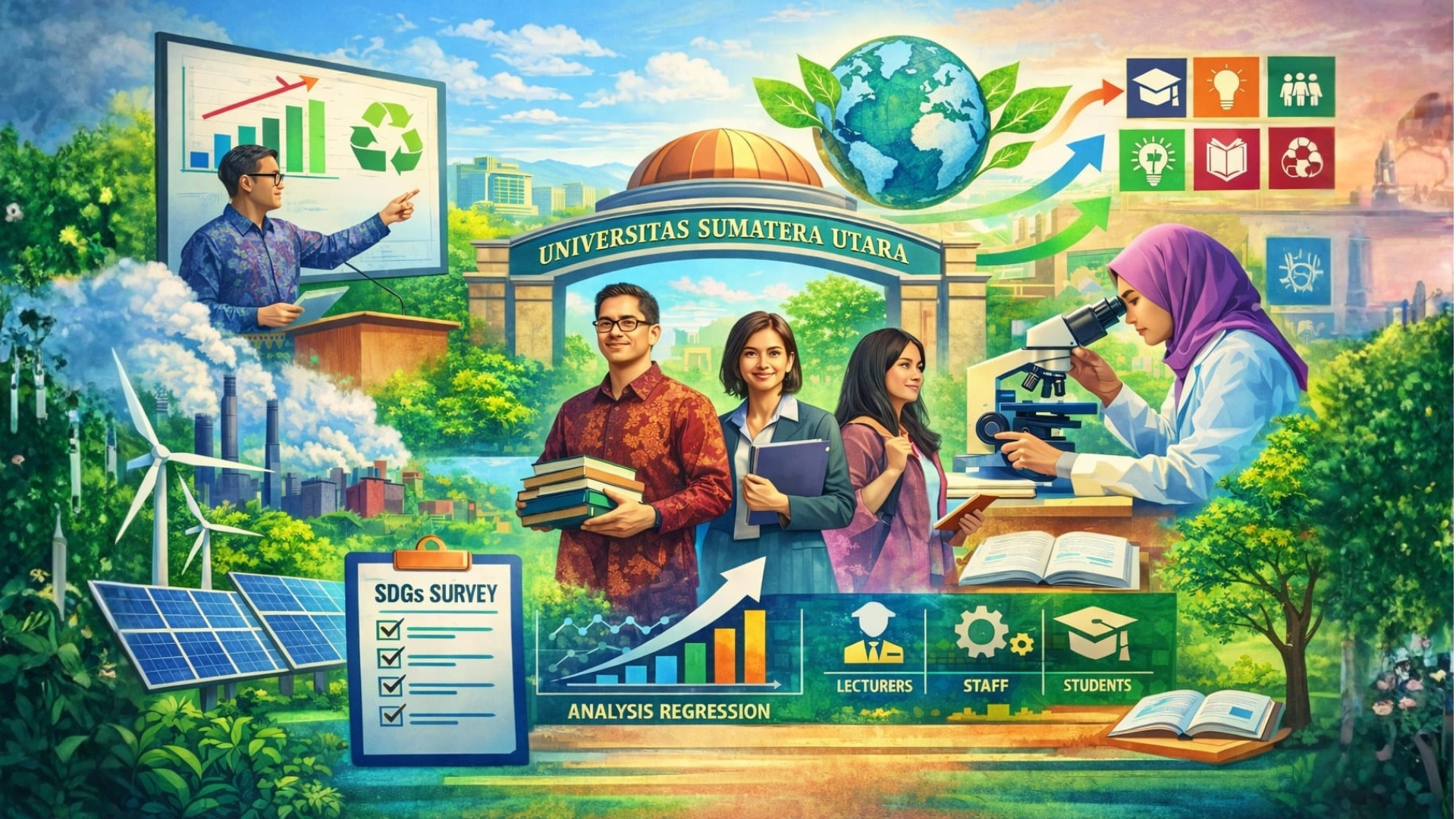
As global higher education institutions are increasingly assessed through environmental, social, and governance performance, Universitas Sumatera Utara (USU) is strengthening its sustainability agenda through institutional programmes, SDGs-oriented reporting, and literacy measurement initiatives. In the QS Sustainability Rankings 2026, USU is listed in the #1101–1150 band, while QS frames sustainability assessment around universities’ social and environmental impact as institutions of education, research, and employment.
Publicly available USU sources indicate that sustainability is not being treated merely as a symbolic discourse. Through its SDGs platform, USU presents sustainability as part of its institutional commitment under the Tridharma of Higher Education, while the university’s SDGs Center reports that it has developed and implemented an SDGs Literacy Survey/Index to assess sustainability understanding and awareness. In one published report from 2024, the SDGs Center noted that participants in the SDGs Ambassador selection process achieved an overall literacy score of 0.82, signalling that sustainability literacy has already entered the realm of measurable institutional performance at USU.
The present assessment adds a more focused layer to that institutional narrative. Based on a questionnaire survey involving 150 respondents using purposive sampling method, divided into three groups—lecturers, education staff, and students—the analysis examined how sustainability literacy is shaped not only by foundational understanding, but also by awareness of institutional programmes, facilities, and implementation pathways on campus. The data were analysed using multiple linear regression, allowing a structured comparison of the factors that most strongly influence applied sustainability literacy in each group.
The results show that sustainability literacy at USU cannot be understood as a single and uniform construct. Instead, it emerges as a differentiated institutional capacity. In all three groups, the regression models explain a substantial proportion of variance, with R² values ranging from 0.736 to 0.814. More importantly, the pattern of influence differs across respondent groups, which means that a single training model would be analytically weak and operationally inefficient as showed in figure 1.
Among lecturers, the most decisive factor is institutional awareness. This is a significant analytical finding because it suggests that the main challenge is not whether lecturers understand sustainability in abstract terms, but whether they can embed it into the actual architecture of academic work. In other words, sustainability becomes meaningful only when it is translated into teaching design, research priorities, and community engagement. The implication is clear: awareness campaigns alone will not be sufficient unless they are followed by academic integration mechanisms.
Among education staff, the pattern is different but equally revealing. Both predictors are significant, yet institutional awareness remains stronger than foundational literacy. This indicates that many staff members are already familiar with the university’s sustainability orientation, but that such awareness has not yet been fully internalised as part of everyday work procedures. Here, the institutional gap is procedural rather than conceptual. Sustainability must therefore move beyond general understanding and enter the domain of administrative routines, office standards, and operational discipline.
Figure1. Survey-to-regression framework for analysing sustainability literacy across lecturers, education staff, and students at Universitas Sumatera Utara.
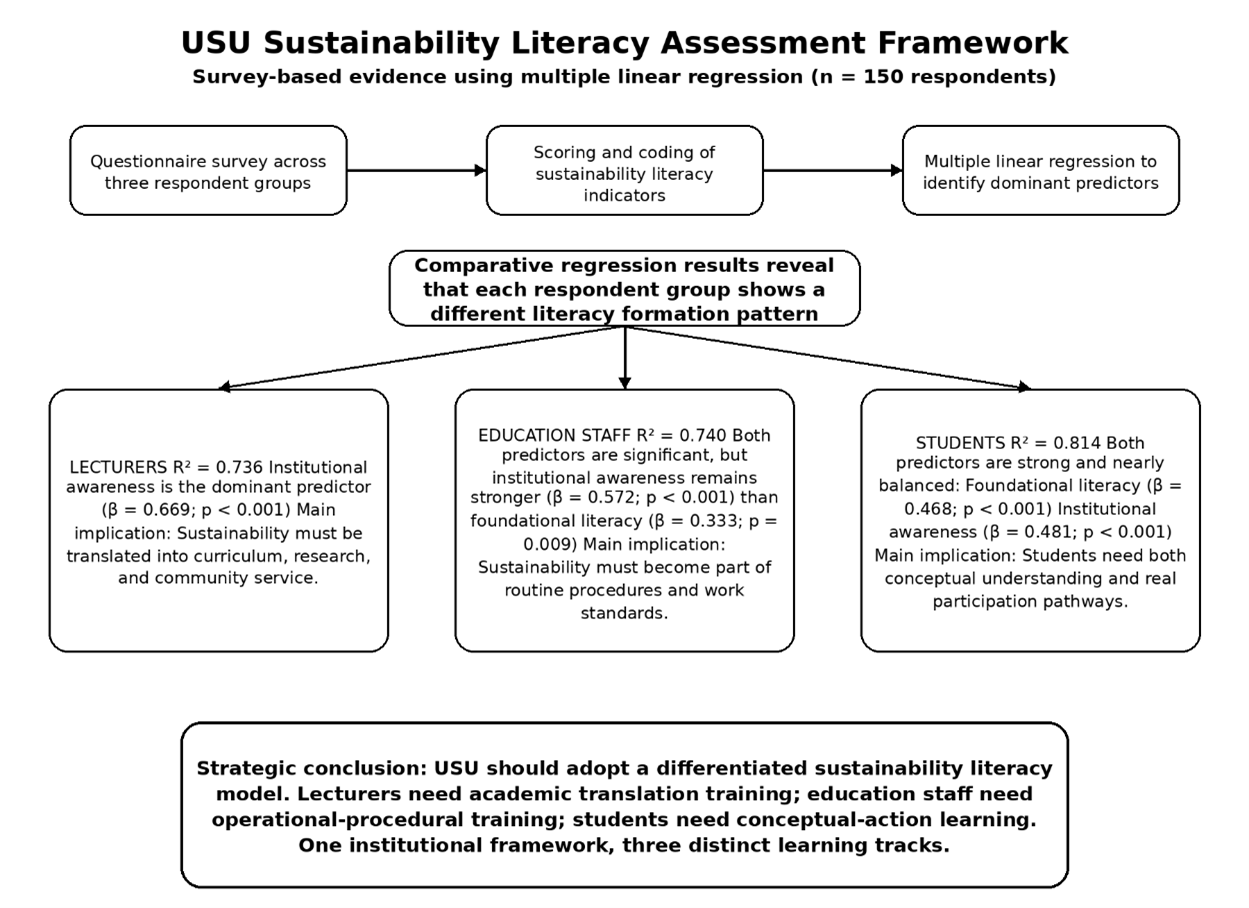
Among students, the evidence shows a dual requirement. Foundational literacy and institutional awareness are both strong and nearly balanced predictors, meaning that students need more than classroom exposure. They require conceptual understanding and visible pathways for participation at the same time. Without institutional channels, sustainability knowledge risks remaining symbolic; without conceptual clarity, participation risks becoming superficial. This makes students the group in which sustainability literacy must be cultivated as both intellectual understanding and lived campus practice.
The visual framework summarises the logic of the study: questionnaire survey, scoring, multiple linear regression, comparative interpretation, and the formulation of a differentiated institutional training model. For a news release or website article, this type of monochrome figure is especially useful because it conveys scientific rigour without sacrificing readability for a broader audience.
Taken together, the findings lead to one central institutional conclusion: USU’s main challenge is not simply to increase sustainability knowledge, but to strengthen the conversion of knowledge into implementation. That is the deeper meaning of the comparative regression results. The three groups do not need the same intervention. Lecturers require academic translation, education staff require operational-procedural integration, and students require concept-to-action learning. The strategic value of the study lies precisely in demonstrating that sustainability literacy must be designed according to role, function, and level of institutional engagement.
This is also why the findings matter beyond the immediate context of an internal survey. In the wider landscape of sustainability assessment, institutions are increasingly expected to demonstrate not only policy declarations, but also measurable educational and organisational transformation. USU’s existing SDGs reporting, literacy measurement initiatives, and sustainability-centred institutional framing already provide a public foundation for that direction. The present survey strengthens that foundation by offering empirical evidence that literacy development at USU should be structured, differentiated, and evidence-based.
In that sense, sustainability literacy at USU should not be seen as a ceremonial agenda or a one-time communication exercise. It should be understood as a long-term institutional capability—one that links university policy to teaching practice, administrative procedures, student participation, and the broader credibility of USU in global sustainability assessment. A university’s position in sustainability rankings is not built by rhetoric alone. It is built by evidence, alignment, and the consistency with which sustainability becomes part of campus life.