


Medan, Indonesia, 2024
Universitas Sumatera Utara (USU) has expanded its sustainability commitment beyond internal operations by requiring all vendors, suppliers, and outsourced service providers to align with the university’s environmental and ethical standards. This commitment is clearly stated in Rector’s Circular No. 1/2023 on Environmental Management and USU’s Commitment to Becoming a Green, Sustainable, and Carbon-Neutral Campus by 2029, which applies to every party operating within the USU ecosystem, including external contractors and outsourcing firms.
Rector’s Circular No. 1 of 2023 on Environmental Management and USU’s Commitment to Becoming a Green, Sustainable, and Carbon-Neutral Campus by 2029 also Rector’s Circular No. 1 of 2023 on Environmental Management and USU’s Commitment to Becoming a Green, Sustainable, and Carbon‑Neutral Campus by 2029 also applies to USU’s vendors, supply chain partners, and outsourced service providers.
A comprehensive sustainability mandate
Building on Rector’s Regulation No. 3/2019 on the Implementation of the Green Campus Movement, USU has developed an integrated sustainability framework that covers procurement, waste reduction, ethical sourcing, and vendor accountability.
The university has formally integrated ethical and sustainable procurement practices into its operations. When sourcing products and services, USU considers environmental, social, and economic impacts and expresses a clear preference for:
- products with eco-labels
- materials that are recycled or recyclable
- energy-efficient equipment and solutions
_11zon.webp)
Vendor partnerships are guided by sustainability criteria that require the use of compostable, recyclable, or reusable materials and the reduction of single-use plastics and other disposable items, in line with USU’s Zero Waste Initiative, which aims to eliminate plastic waste from university operations by 2030.
Sustainability clauses in vendor contracts
USU has begun to embed specific sustainability clauses into vendor contracts and procurement processes. These clauses:
- encourage and, where appropriate, require the use of reusable, recyclable, and compostable materials
- oblige food service vendors to minimise single-use plastics and adopt waste separation practices
align service delivery with USU’s integrated waste management system

In food services and public events, for example, vendors are expected to avoid single-use packaging, provide refill options, and ensure proper segregation of organic and inorganic waste. Through the Procurement Unit (UKPBJ) and the Bureau of Asset and Business Management (BPAU), USU monitors vendor compliance and offers guidance, feedback, and training so that suppliers understand and can meet the university’s sustainability requirements.
Green supply chains and local partnerships
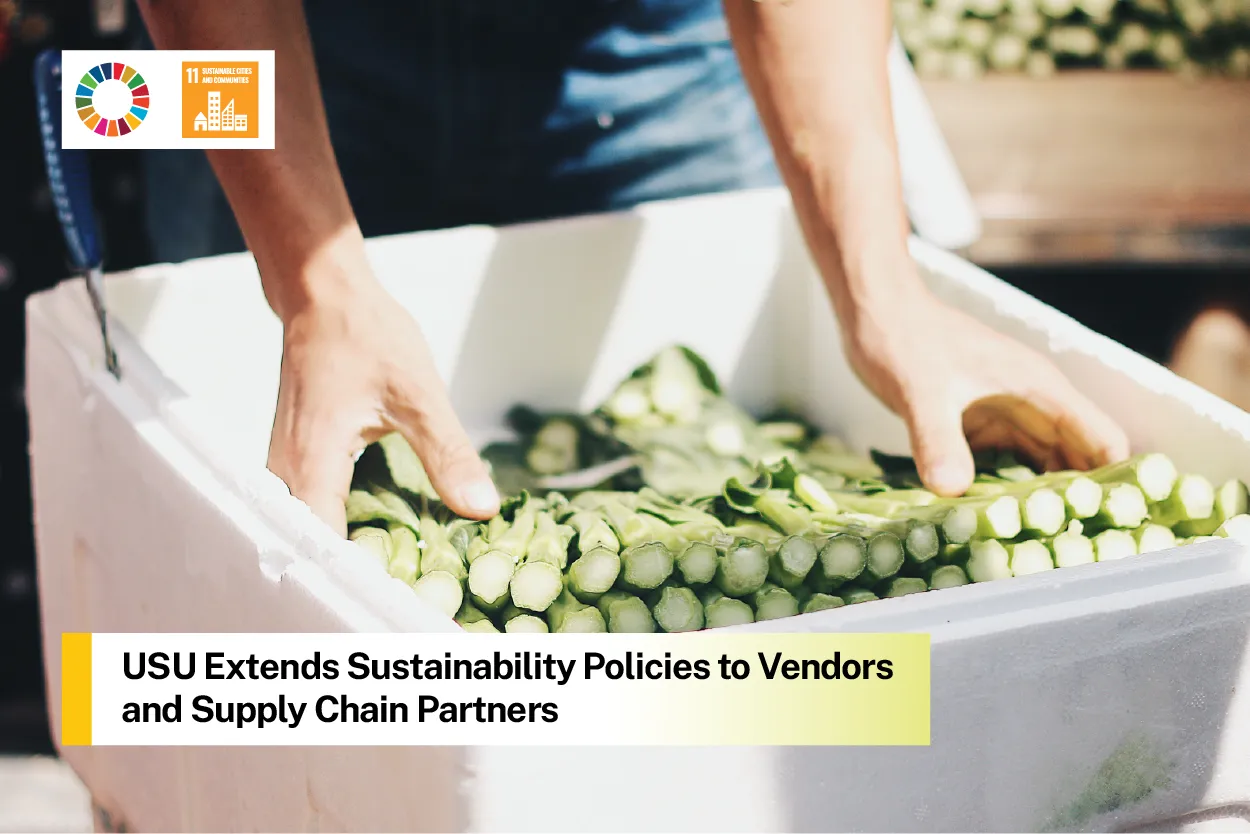
USU’s sustainability vision also has a local economic dimension. More than 65 percent of campus food and agricultural products are now sourced from local and sustainable producers, including farmers in Desa Binaan (community development villages) supported by the university. This local sourcing strategy reduces transportation-related emissions, supports regional livelihoods, and promotes sustainable agriculture in surrounding communities.
Vendors providing janitorial, catering, and construction services are encouraged to adopt environmental management systems and waste reduction protocols. These measures are part of USU’s broader effort to embed circular economy principles into its operations, supported by research and innovation from the USU Green Campus Team (UIGM).
Accountability through data and continuous improvement
USU’s environmental policies are evidence-based and data-driven. The university conducts regular waste audits and uses digital tools to monitor waste generation, recycling rates, and landfill diversion. Vendors are required to report on their waste management practices and performance, creating a transparent and measurable accountability framework.
The Integrated Waste Management Facility (TPST) plays a central role in this system. It processes organic and inorganic waste using technologies such as:
- pyrolysis for plastic waste
- maggot cultivation for organic waste
Vendors are expected to support these efforts through proper source segregation and by minimising contamination of recyclable and compostable streams.
Building capacity in sustainable supply chain management
Recognising that long-term success depends on shared understanding and skills, USU also implements sustainability education and certification programmes for both internal staff and external partners. These programmes enhance capacity in:
- sustainable procurement
- waste reduction and resource efficiency
responsible supply chain management
Through workshops, training sessions, and collaborative projects, USU equips vendors and staff with the knowledge and tools needed to apply sustainability principles in day-to-day operations.
A model for institutional sustainability
By extending its sustainability policies to outsourced services and supply chain partners, Universitas Sumatera Utara demonstrates that environmental responsibility is not limited to campus facilities alone but includes every operational relationship connected to the university.
Circular No. 1/2023 underscores that environmental stewardship is a shared obligation among all who work within and alongside USU. With this inclusive approach, the university advances SDG 12 (Responsible Consumption and Production) and sets a national example for ethical procurement and sustainable university governance, showing how a higher education institution can help shape an entire ecosystem toward a more responsible, resilient, and sustainable future.