


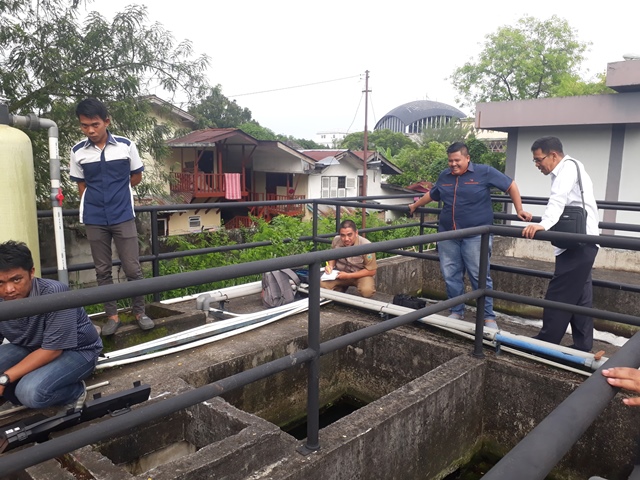
On Tuesday, December 12, 2017, a team from the UPT River Water Quality Management Office of Belawan-Deli, led by Ka UPT Ir. H. Taufik Batubara, MSi, conducted an inspection of the wastewater treatment plant (IPAL) at the Universitas Sumatera Utara Hospital (RS USU). The inspection aimed to assess the performance of the IPAL, which processes water from the Deli River area. The evaluation was intended to determine whether the treated wastewater, discharged through the outlet, meets the required quality standards, ensuring that it does not pollute the surrounding water bodies.
During the field inspection, key parameters were measured, including pH, temperature, TDS (Total Dissolved Solids), turbidity, and DO (Dissolved Oxygen) levels. According to Taufik Batubara, this was the first inspection of wastewater discharges into public waters since the establishment of the UPT River Water Quality Management Office. For the USU Hospital's wastewater, the results were as follows: pH 7.44, Temperature 28.3°C, Conductivity 1,439, TDS 680, Turbidity 1.48, and DO 6.84, all of which fall within normal limits.
Furthermore, based on the November 2017 waste quality test results, as confirmed by the certificate issued by the SUCOFINDO Laboratory, the wastewater was found to meet the required standards and is considered safe, not posing a risk of pollution. However, the Environmental Agency of North Sumatera (BLH Provsu) recommended that the hospital continue optimizing the performance of the IPAL to ensure it can efficiently treat the wastewater generated and maintain environmental safety.
Director of Facilities and Support Services, Dr. Achmad Delianur Nasution, ST. MT, along with Head of the IPAL Unit, Eko Wibowo, AMKL, shared that the USU Hospital was built with funding from the Islamic Development Bank (IDB). According to Dr. Achmad Delianur Nasution, who is also the architect of the USU Hospital, the IDB closely supervised the project from the proposal stage through to construction, with a strong focus on ensuring compliance with waste management standards. As a result, the wastewater treatment system (IPAL) at USU Hospital was designed from the outset to meet all relevant standards.
Currently, USU Hospital operates 17 outpatient clinics covering a wide range of specialties, including pediatrics, surgery, obstetrics and gynecology, internal medicine, ENT, ophthalmology, neurology, dermatology, cardiology, medical rehabilitation, neurosurgery, orthopedics, pediatric surgery, developmental growth, psychiatry, respiratory care, and anesthesiology. The hospital currently has 109 operational beds, with plans to expand to a total of 165 beds.