


Medan, Indonesia (30 September 2024) – Universitas Sumatera Utara (USU) is reinforcing its commitment to environmental sustainability through a formal plastic waste reduction action plan under the Green Campus Movement. This plan brings together clear rector-level policies, improved waste infrastructure, and active student participation to reduce dependence on single-use plastics and move the campus toward a low‑waste cultures
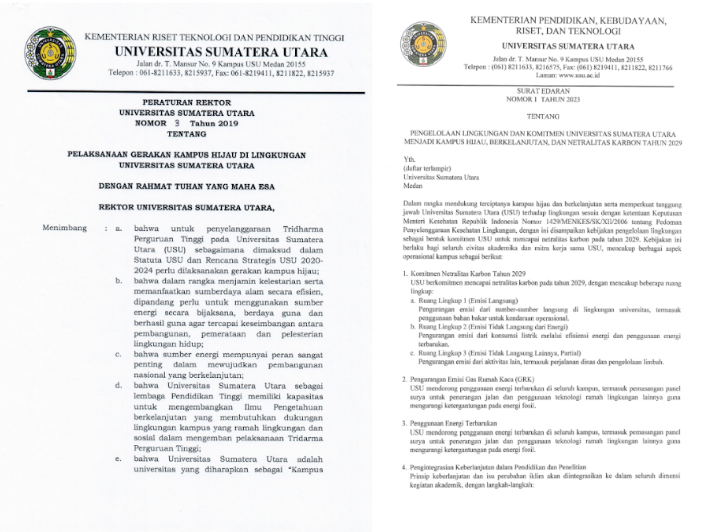
Rector’s Regulation No. 3 of 2019 and Rector’s Circular No. 1 of 2023 serve as USU’s action plan to reduce plastic waste across campus.
The policy framework is set out in Rector’s Regulation No. 3 of 2019 on the Implementation of the Green Campus Movement, and further detailed in Rector’s Circular Letter No. 15129/UN5.1.R/KPM/2022 on the optimisation of sustainable food and the elimination of single-use plastics. These instruments translate national government regulations on environmental management and waste reduction into a concrete institutional action plan that applies to all units, facilities, and vendors at USU.
Eliminating single-use plastics and promoting 3R practices
At the core of the action plan is a phased elimination of single-use plastics in campus life. The Rector’s Circular instructs all faculties, administrative offices, and event organisers to:
stop using single-use plastic bottles, cups, straws, and plastic shopping bags wherever alternatives are available;
apply the 3R principles (Reduce, Reuse, Recycle) in daily activities and procurement;
encourage the use of reusable items such as tumblers, refillable drinking bottles, lunch boxes, and eco-bags.
To support this behavioural change, USU has installed segregated waste bins and recycling stations in major campus areas, including the Faculties of Medicine, Pharmacy, Engineering, Forestry, and Law. These facilities make it easier for the campus community to separate plastic, paper, organic, and residual waste, helping to ensure that recyclable materials are not mixed with general waste and reducing the risk of plastic leakage into drains, rivers, and eventually coastal waters.
Infrastructure, partnerships, and education for change
.jpg)
A four-compartment waste station designed to separate hazardous (B3) waste from recyclable materials, supporting proper waste management and 3R practices.
The plastic reduction strategy is backed by visible supporting infrastructure, such as:
drop boxes for recyclable materials and hazardous waste (B3);
public signage and awareness posters that discourage unnecessary plastic use;
green corners and collection points dedicated to sustainable waste management.
Implementation is coordinated by USU’s Healthy Campus Team and Green Campus Unit, which work with local environmental agencies and private waste‑management partners to ensure that separated waste is transported, processed, and recycled appropriately.
Students play a central role in sustaining change. Through programmes such as Duta Green Campus (Green Campus Ambassadors), USU trains student volunteers to:
organise workshops and campaigns on plastic reduction and 3R practices;
run competitions and social media activities that promote low‑waste lifestyles;
support faculties and student organisations in applying plastic‑free guidelines at their events
.png)
The “Talk-Inspirazi” event encourages the USU community to promote inclusivity and eco-friendly practices, supporting the university’s Action Plan to Reduce Plastic Waste Across Campus.
As part of this education effort, USU also promotes inclusivity and environmental awareness in public events. One example is the Talk-Inspirazi session on “Creative Thinking & The Art of Storytelling” held in the Prof. Dr. Suhadji Hadibroto Hall, Faculty of Economics and Business, where participants were encouraged to apply creative communication to advance messages about inclusivity, sustainable living, and environmentally friendly practices in all campus activities.
Environmental topics are integrated into extracurricular activities like these, helping to ensure that plastic awareness and sustainable behaviour become part of everyday student culture rather than one-time campaigns.
Governance, monitoring, and institutional commitment
All actions under the plastic reduction action plan are anchored in:
Rector’s Regulation No. 3 of 2019 on Green Campus Implementation, which sets the overall direction for low‑carbon, low‑waste campus operations;
Rector’s Circular Letter No. 15129/UN5.1.R/KPM/2022, which specifically targets single-use plastics and sustainable food packaging;
Circular Letter No. 1 of 2023 on Environmental Management and Carbon Neutrality 2029, which links plastic reduction and waste management to USU’s broader climate and sustainability goals.
These rector-level instruments ensure that national regulations and ministry guidelines on waste and plastic management are not only acknowledged but operationalised at the university level. They provide a clear mandate for faculties, units, and vendors to align procurement, catering, and event management with the principles of waste minimisation and responsible consumption.
By combining policy, infrastructure, partnerships, and sustainability education, Universitas Sumatera Utara demonstrates how a university can implement a practical action plan that changes everyday behaviour. The ongoing programme to minimise plastic waste is not only a step toward a greener campus, but also a model for how higher education institutions can foster an enduring culture of environmental responsibility among students, staff, and vendors.