


Medan, (December 04, 2024) — Universitas Sumatera Utara (USU) continues to reinforce its role in climate-change mitigation and adaptation through scientific research, technical assistance, and close cooperation with national and international partners. By integrating its expertise into disaster preparedness and spatial-planning processes, the university contributes directly to resilience building and sustainable environmental governance in Indonesia, particularly in regions vulnerable to climate-related disasters and displacement. Climate action is not treated as a stand-alone project, but embedded in USU’s institutional frameworks and external partnerships.
 USU has embedded its climate action plan within Rector’s Regulation No. 3 of 2019 on the Implementation of the Green Campus Movement and related sustainability instruments, further reinforced by Circular Letter No. 1 of 2023 on Environmental Management and the Commitment to Achieve Carbon Neutrality by 2029. This embedded plan focuses on cutting carbon emissions, adopting renewable energy, managing waste sustainably, and engaging communities, while also recognising the need to anticipate and respond to climate-related hazards such as floods, fires, and peatland degradation. Although the university has not issued a single stand-alone Climate Action Plan document, its coordinated efforts across faculties, research units, and community programmes effectively function as an integrated climate action plan that is shared and refined with regional partners.
.webp)
Universitas Sumatera Utara actively engages in cooperative planning for climate change-related disasters and displacement, working with both national and international counterparts. According to its official reporting, USU contributes through research, technical assistance, and policy collaboration with government agencies and development institutions. A key example is the involvement of the Faculty of Forestry in the GIZ-SUPA Project (Sustainable Use of Peatland and Haze Mitigation in ASEAN). Working alongside the Ministry of Environment and Forestry (KLHK), the University of Syiah Kuala, and GIZ (German Development Cooperation), USU supported the finalisation of Regional Spatial Plans (RPPEG) for Aceh Barat and Nagan Raya. This initiative addresses resilience building, sustainable land use, and climate-driven displacement risks through improved peatland management—an essential component in reducing haze, limiting land degradation, and lowering the likelihood of forced migration due to climate-related disasters.
Beyond peatland-focused work, USU’s research units and community-service programmes conduct risk mapping, environmental modelling, and ecosystem assessments designed to inform local policies and emergency preparedness. The university collaborates with regional planning agencies (Bappeda) on technical studies such as Regional Action Plan Assessments in sectors including agriculture, waste reduction, and mercury elimination. Faculties—particularly Forestry and Environmental Science—lead climate-resilience modelling, ecosystem vulnerability analyses, reforestation initiatives, and carbon-sequestration education, often in collaboration with national and international experts. These partnerships ensure continuous communication between USU and local governments so that academic findings and field data feed into spatial planning, emergency-response frameworks, and climate-adaptation strategies.
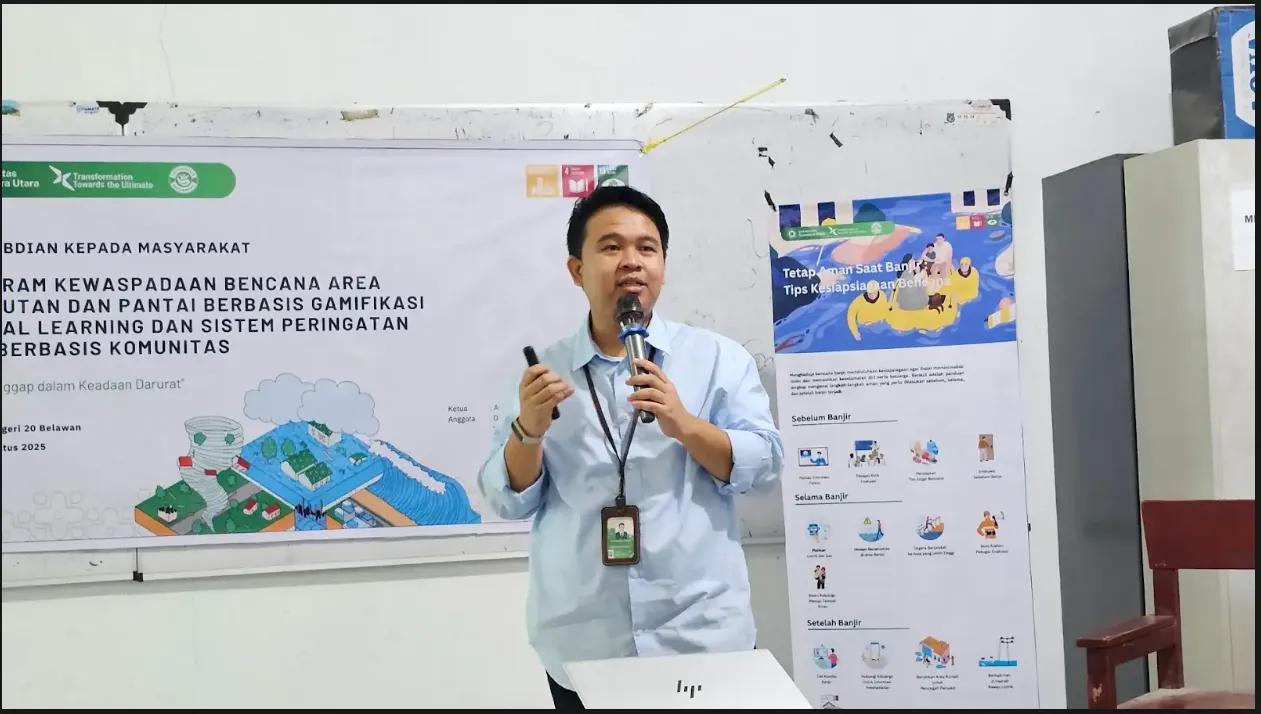
Community engagement is another critical dimension of USU’s contribution to climate resilience. Through its community service programmes, the university integrates environmental risk communication, forest and peatland resilience, and disaster-adaptation training for local communities. Working directly with villages, schools, and local institutions, USU helps stakeholders better understand the risks of floods, fires, and land degradation, and supports them in developing practical strategies to minimise their impacts. This includes assisting local authorities in mainstreaming environmental risk into spatial-development policies and preparedness plans, ensuring that both human and ecological vulnerabilities are considered.
Rector Professor Dr. Muryanto Amin, S.Sos., M.Si., has emphasised that scientific collaboration is essential for effective disaster preparedness and climate governance. By contributing research, technical expertise, and advisory input, USU supports local and regional authorities in developing adaptive policies that protect communities and ecosystems alike. Through its multidisciplinary contributions to spatial planning, risk mapping, peatland management, and environmental governance, Universitas Sumatera Utara advances the objectives of Sustainable Development Goal 11 (Sustainable Cities and Communities) and Sustainable Development Goal 13 (Climate Action), demonstrating how higher-education institutions can help shape policy, strengthen regional preparedness, and support Indonesia’s broader transition toward climate-resilient development.