


.webp)
Medan, 2024 – Universitas Sumatera Utara (USU) reaffirms its role as a neutral and safe platform for open discussion on public policy and political issues. Guided by Academic Senate Regulations No. 01 of 2017 and No. 01 of 2022, the university protects academic freedom and institutional neutrality while encouraging evidence-based debate among students, lecturers, government representatives, and civil society.
USU positions itself not as a partisan actor, but as a meeting point where different perspectives can be heard, questioned, and refined in an academic atmosphere.
A neutral forum for policy dialogue
In 2024, USU strengthened this role through a range of public forums and discussions. One key initiative was the USU Governance and Policy Forum, organised by the Faculty of Social and Political Sciences (FISIP USU) and the Institute for Research and Community Service (LPPM USU).
The forum brought together representatives from the Provincial Government of North Sumatra, Bappeda, civil society organisations, and academics to discuss regional governance and innovation for the RPJMD 2025–2029. The sessions focused on how evidence and research can inform regional planning, public participation, and institutional reform.
USU also hosted a Public Lecture on Green Economy and Local Governance, which provided a safe space to discuss climate adaptation, waste management, and low‑carbon development policies. These activities show how the campus serves as a bridge between science and policy, allowing stakeholders to explore complex issues without tension or political branding.
Student forums on national identity and democracy
At the student level, the Faculty of Social and Political Sciences (FISIP USU) played a central role in nurturing critical thinking and civic awareness.
The Forum Diskusi Aktual Berbangsa dan Bernegara offered regular open discussions on current national issues, citizenship, and governance. Academics and practitioners were invited to unpack pressing public debates and policy challenges, helping students understand political dynamics beyond social media narratives.
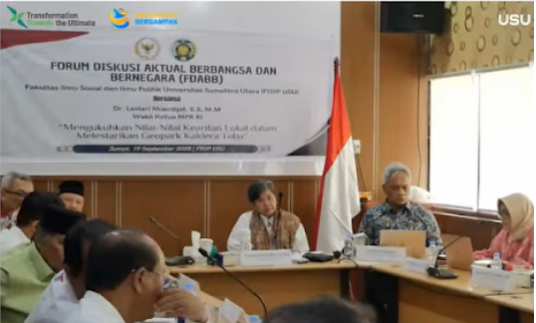
(source: instagram.com/usutv)
The Student Executive Body of FISIP (PEMA FISIP) organised a Dialog Kebangsaan titled “Peran Pemuda dalam Melawan Pengaruh Asing” (The Role of Youth in Resisting Foreign Influence). The dialogue highlighted the importance of political literacy, national identity, and active youth participation in democratic processes.
.png)
These activities underline USU’s commitment to giving students room to question, debate, and form reasoned opinions in a structured and respectful academic setting.
Legal scholarship supporting democratic institutions
.png)
The Faculty of Law (FH USU) complements these efforts by engaging directly with national legal and democratic agendas.
The Dean of FH USU took part in the National Declaration of the Association of Deans of Law Faculties of State Universities in Indonesia (BKS Dekan FH PTN se‑Indonesia), emphasising the collective role of law faculties in upholding the rule of law, judicial independence, and good governance.
.png)
FH USU also organised a Focus Group Discussion (FGD) titled “Penguatan Partai Politik sebagai Pilar Demokrasi” (Strengthening Political Parties as Pillars of Democracy). The FGD brought together legal experts, political scientists, and practitioners to discuss how political parties can support democratic consolidation, avoid polarization, and contribute to cleaner, more accountable politics.
Safeguarding academic freedom and civic space
Through these forums, lectures, and discussions, USU creates an environment where sensitive political topics can be explored calmly and critically. The university’s role is to:
guarantee academic freedom and freedom of expression within ethical and legal boundaries;
maintain institutional neutrality while opening its doors to diverse stakeholders;
ensure that debate is grounded in data, research, and reasoned argument rather than propaganda.
This approach is fully consistent with USU’s governance framework and its broader collaboration with government and civil society, where academic experts contribute to regional planning, policy design, and public consultation processes.
Advancing SDG 16 through dialogue and knowledge
By providing a safe and academic space for political discourse, Universitas Sumatera Utara directly supports SDG 16: Peace, Justice, and Strong Institutions. Open forums, policy dialogues, and student‑led discussions help:
build political awareness and democratic skills among young people;
strengthen trust between universities, government, and the public;
promote transparent, participatory, and informed governance.
In doing so, USU shows that universities can be more than centres of learning: they can be neutral arenas where ideas are tested, disagreements are managed constructively, and the foundation for a more peaceful and just society is quietly, steadily built.