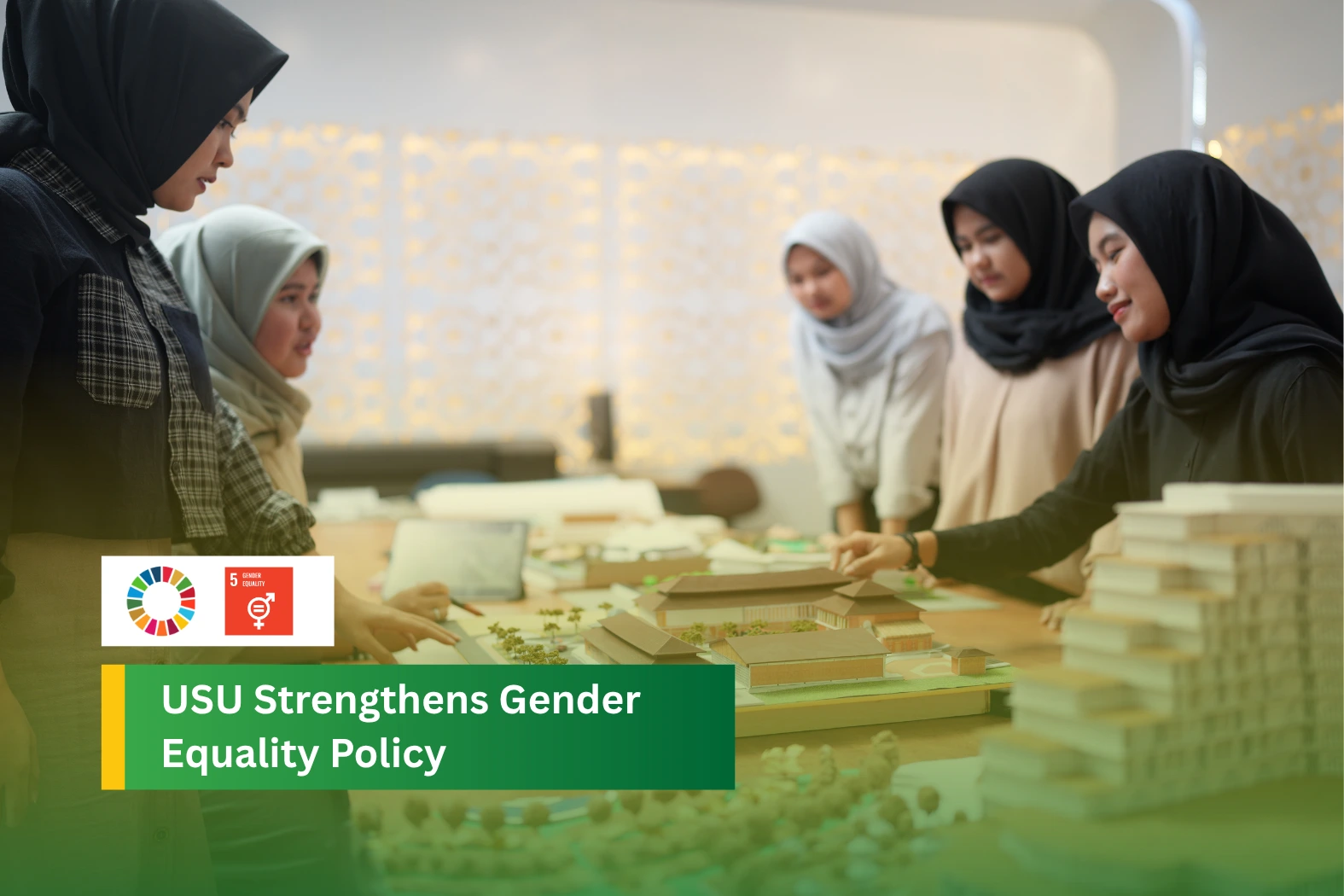
Medan, 20 November 2024 — Universitas Sumatera Utara (USU) has reinforced its institutional commitment to gender equity and inclusive participation through a comprehensive policy framework that ensures equal opportunities for women in university admissions, retention, and advancement. These policies reflect USU’s alignment with both national higher education standards and the UN Sustainable Development Goals, particularly SDG 4 (Quality Education) and SDG 5 (Gender Equality).

Policy Foundations: Justice, Equality, and Accountability
USU’s gender equity framework is legally anchored in Academic Regulation No. 13 of 2022, Chapter II, which defines justice, transparency, equality, and accountability as core principles of academic and administrative governance.
To operationalize these values, the university issued Rector’s Decree No. 459/UN5.1.R/SK/SPB/2023, which mandates the implementation of inclusive practices in admissions, participation, and student support systems across all faculties. These policies explicitly require that admission procedures, scholarships, and development initiatives be free from discrimination based on gender, ethnicity, religion, or socioeconomic background.
“Our governance framework ensures that inclusion and equality are not only principles but measurable commitments,” said Rahma Yurliani, S.Psi., M.Psi., Head of the Directorate of Students and Alumni Affairs. “By embedding gender sensitivity into every stage of policy and practice, USU guarantees fair opportunity for all.”

Data Monitoring and Evaluation to Ensure Accountability
Implementation of these policies is supported by systematic data collection through the Academic Bureau Directorate of Students and Alumni Affairs, which annually monitors women’s participation across 17 faculties.
In 2024, the data confirmed strong female participation: women represented 56% of all applicants, 55% of accepted students, and 54% of new degree entrants. Notably, the university recorded measurable increases in female enrolment within STEM fields such as Engineering, Agriculture, and Computer Science. These findings are compiled in the university’s Gender Equality Monitoring Report, serving as the basis for continuous policy review and resource allocation.

Inclusive Access Through Outreach and Scholarships
USU integrates its inclusivity principles into practical outreach and scholarship programmes such as Poverty-Targeted Scholarship, which prioritizes access for women from rural and economically disadvantaged backgrounds. Complementary initiatives—including mentorship programmes, leadership workshops, and academic advisory systems—are coordinated by the Directorate of Education Development and the Center for Independent Learning to enhance student success and empowerment.
The effectiveness of these initiatives is evaluated through institutional surveys, focus groups, and policy audits, ensuring transparency and ongoing improvement.
“Gender equity is integral to USU’s vision of sustainable and inclusive education,” stated Prof. Dr. Muryanto Amin, S.Sos., M.Si., Rector of Universitas Sumatera Utara. “Through continuous monitoring, outreach, and empowerment programmes, we ensure that women have equal access and the opportunity to excel across all academic disciplines.”
By embedding gender inclusivity into its governance, operations, and monitoring systems, USU ensures that women have fair and equitable access to education and professional development, solidifying its role in leading a gender-balanced and accountable higher education ecosystem that supports social justice and sustainable development in Indonesia.