


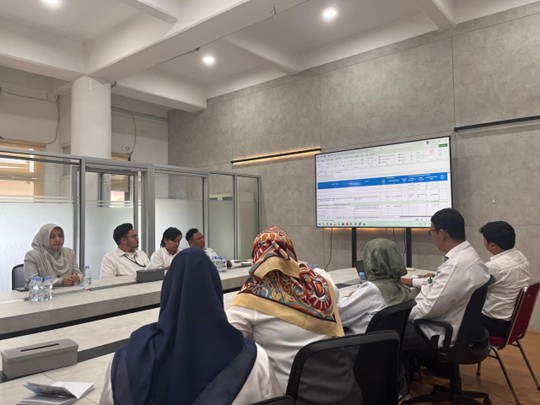
A strategic policy meeting was held on November 18, 2025, at the Equity Meeting Room, 3rd Floor, Rectorate Building, chaired by Himsar Ambarita, Director of the Directorate of Internationalization and Global Partnerships. The meeting brought together key stakeholders to finalize a structured Greenhouse Gas Emission Reduction Action Plan for the university.
USU’s climate action strategy is grounded in a robust emissions inventory. In 2024, the university recorded 734 tons CO₂e from Scope 1 and Scope 2 emissions, establishing a clear baseline for reduction efforts.
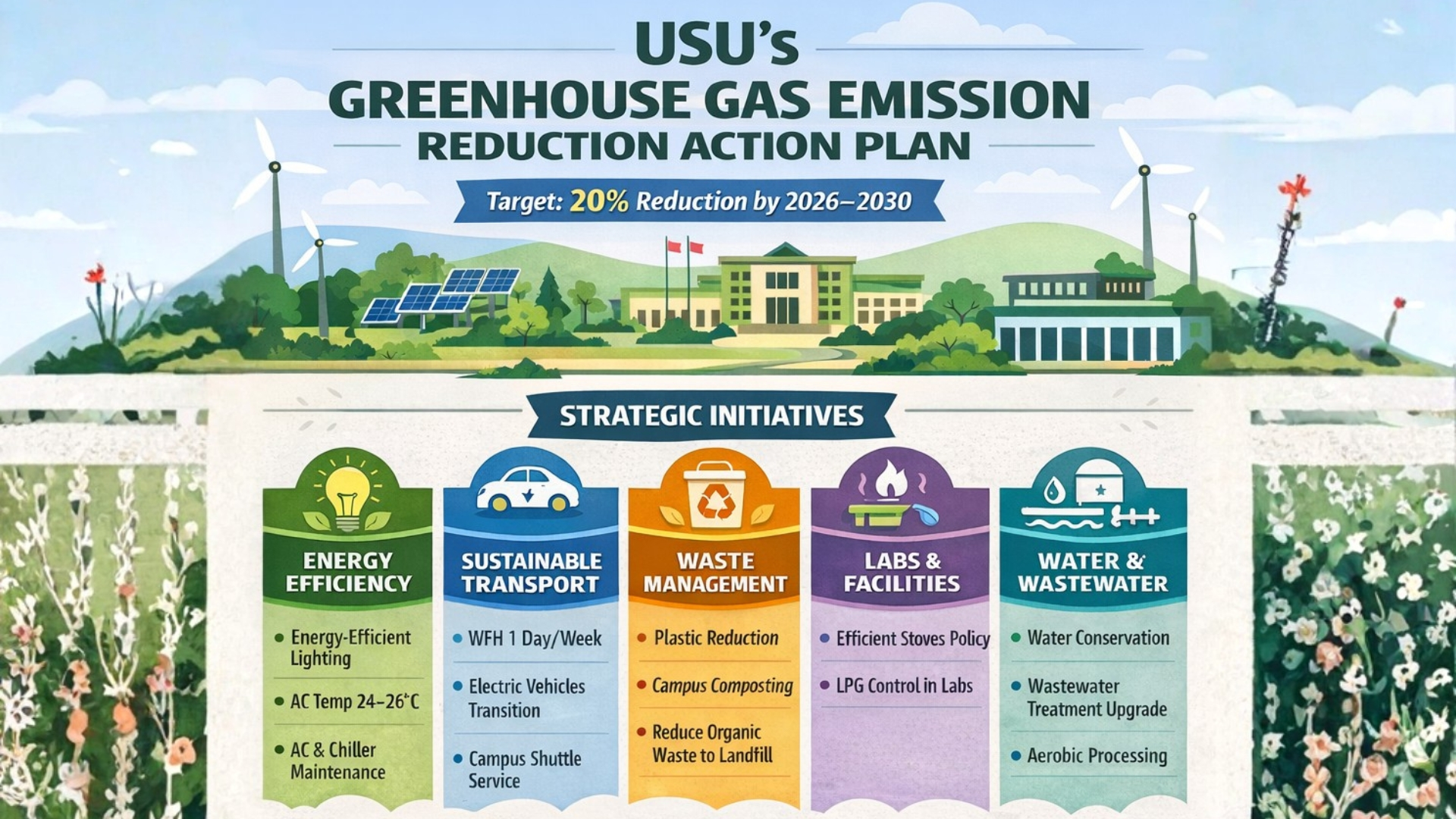
With a firm commitment to sustainability, USU has set a 20% reduction target by 2030, lowering emissions to 586.513 tons CO₂e. This target is supported by a progressive annual reduction pathway, ensuring a realistic and scalable transition toward a low-carbon campus:
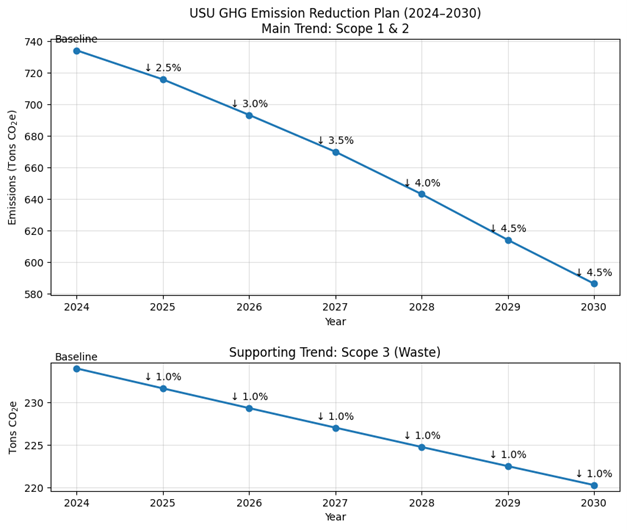
In parallel, Scope 3 emissions from waste management are also being systematically reduced, from 234 tons CO₂e in 2024 to 220.306 tons CO₂e by 2030, demonstrating USU’s commitment to tackling indirect emissions through sustainable waste practices.
Strategic Policy Framework for Emission Reduction
To achieve this ambitious target, USU has developed an integrated policy framework consisting of 18 key policy instruments, addressing multiple emission sectors in a holistic and measurable manner:
1. Energy Efficiency and Building Management
USU prioritizes energy efficiency as a primary mitigation strategy through:
Policy on the Use of Energy-Efficient Lighting, ensuring campus-wide transition to low-energy lighting systems such as LED technology;
Policy on Air Conditioning (AC) Temperature Regulation, mandating a minimum temperature setting of 24–26°C, combined with restrictions on operational hours for both AC systems and lighting;
Standard Operating Procedures (SOP) for AC and Chiller Maintenance, to ensure optimal performance and energy efficiency of cooling systems;
Policy on Gradual Standardization of Low Global Warming Potential (GWP) Refrigerants, aimed at reducing indirect emissions from cooling systems.
2. Sustainable Mobility and Transportation
Recognizing transportation as a significant contributor to campus emissions, USU introduces:
Work-from-Home (WFH) Policy (one day per week) to reduce commuting-related emissions;
Policy on Limiting Non-Priority Official Vehicles, to minimize unnecessary fuel consumption;
Policy on Gradual Reduction of Fossil Fuel-Based Vehicles, promoting a long-term shift away from carbon-intensive transportation;
Policy on Gradual Transition to Electric Vehicles (EVs) within university operations;
Campus Internal Shuttle Policy, providing shared, low-emission mobility solutions to reduce individual vehicle use.
3. Energy Use in Laboratories and Facilities
To address emissions from specialized campus operations:
Policy on Standardization of Energy-Efficient Stoves, particularly in laboratory and operational settings;
Policy on Controlling LPG and Fuel Use in Laboratories, ensuring efficient and monitored energy consumption in academic and research activities.
4. Waste Management and Circular Economy
USU emphasizes waste reduction and circular practices through:
Policy on Single-Use Plastic Reduction, aiming to minimize plastic waste generation across campus;
Campus Composting Program, converting organic waste into useful resources;
Policy on Reducing Organic Waste Sent to Landfills (TPA), lowering methane emissions from waste decomposition.
5. Water Management and Wastewater Treatment
To reduce emissions associated with wastewater and improve environmental quality:
Policy on Water Conservation, reducing water consumption and consequently lowering wastewater volume;
Policy on Monitoring Domestic and Canteen Wastewater Quality, ensuring compliance with environmental standards;
Policy on Improvement of Wastewater Treatment Systems (IPAL) and Septic Tanks, enhancing treatment efficiency and emission control;
Policy on Increasing the Proportion of Aerobic Treatment Systems, which are generally associated with lower methane emissions compared to anaerobic processes.
Data-Driven and Impact-Oriented Implementation
All policies are designed based on a data-driven emission inventory, ensuring that each intervention contributes measurably toward the overall reduction target. The integration of policies across sectors enables USU to address both direct emissions (Scope 1) and indirect emissions (Scope 2 and Scope 3) in a coordinated manner.
The implementation of this action plan will be supported by continuous monitoring, periodic evaluation, and institutional collaboration, ensuring alignment with international sustainability indicators and best practices.
Advancing SDGs and Global Sustainability Rankings

This initiative directly contributes to SDG 13: Climate Action, while also supporting other interconnected goals such as SDG 7 (Affordable and Clean Energy), SDG 11 (Sustainable Cities and Communities), and SDG 12 (Responsible Consumption and Production).
Through this comprehensive policy framework, USU positions itself as a forward-looking institution committed to reducing its carbon footprint and fostering a sustainable campus ecosystem. The university aims not only to achieve its emission reduction targets but also to serve as a national and regional model for sustainable higher education institutions, strengthening its global visibility in sustainability rankings such as QS Sustainability.