


.webp)
Medan, (October 22, 2024) — Universitas Sumatera Utara (USU) is sharpening its role in Indonesia’s climate transition by operating an institution‑wide, funded carbon‑management process that combines clear targets, annual measurement, and verified emission‑reduction programmes. Anchored in Rector’s Circular No. 1 of 2023 on Environmental Management and Carbon Neutrality by 2029, the university is moving systematically toward a low‑carbon campus, positioning itself as a leading example in the national green‑campus movement.
USU’s carbon‑management process is formalised as a structured plan–implement–monitor cycle. First, the university runs a greenhouse‑gas reduction programme that explicitly covers Scope 1, Scope 2, and selected Scope 3 emissions across operations. Second, it conducts annual carbon‑footprint accounting, with emissions over the last 12 months recorded at 734 tCO₂, equivalent to less than 0.10 tCO₂ per person per year across a campus population of nearly 47,000 people. Third, USU tracks energy use—803,081 kWh per year—through digital metering and ICT‑based monitoring. Finally, the process is backed by a dedicated sustainability budget of USD 23.35 million, which finances continuous improvement in infrastructure, operations, and behaviour‑change initiatives.
Within this framework, technical measures play a central role. Smart‑building controls and energy‑efficient appliances now cover about 38 percent of total floor area, allowing real‑time optimization of lighting, ventilation, and air‑conditioning. Building Automation Systems (BAS) manage loads across 83,988 m² of space, using timers, motion sensors, and centralised control to reduce idle consumption while maintaining comfort in classrooms, laboratories, and offices. These systems are complemented by design features—daylighting, natural‑ventilation corridors, and shaded façades—that lower cooling demand before any equipment is switched on.
On the supply side, USU operates a growing portfolio of on‑site renewable‑energy systems, including solar, wind, and pico‑hydro installations. Together, these sources provide roughly 1.85 percent of the university’s annual electricity needs, demonstrating how small‑scale distributed generation can meaningfully contribute to campus operations. Rooftop solar arrays on administrative and academic buildings, solar‑powered lighting, and renewably powered charging points are visible signs of this shift, reinforcing a culture in which clean energy is part of the daily experience of studying and working at USU.
.webp)
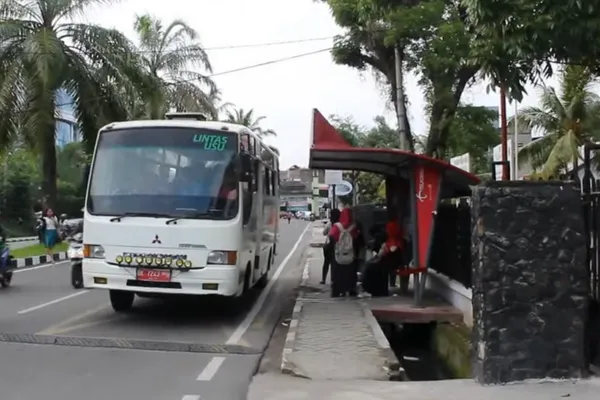
Low‑carbon transport is another pillar of the university’s approach. USU operates a free campus‑shuttle system and promotes zero‑emission vehicles (ZEVs), including bicycles and e‑motorcycles, to reduce reliance on private fossil‑fuel vehicles. Internal benchmarking indicates a very low vehicle‑to‑population ratio, supported by policies that prioritise shared and non‑motorized mobility. These efforts reduce direct and indirect emissions from commuting and circulation, while also making the campus more pedestrian‑friendly and accessible.

Nature‑based solutions are woven through the carbon‑management plan. Retention ponds, campus greening, and tree‑planting programmes help absorb carbon, regulate microclimates, and mitigate flood risks in Medan. Initiatives such as mangrove restoration, eco‑enzyme development from organic waste, and research on alternative biofuels further link ecological design with emission reduction. Many of these activities are structured as joint projects between faculty and students, turning the campus into a laboratory where climate science, engineering, and policy are tested in real settings.
Digitalisation underpins planning and oversight. Platforms such as E‑Office, SIMPEL, and SIMABDIMAS reduce paper use and streamline administrative workflows, while integrated ICT tools feed data from meters, sensors, and renewable‑energy systems into central dashboards. The Energy and Climate Team uses these datasets to evaluate the performance of reduction programmes, identify areas of high consumption, and prioritise investments. The same information supports reporting to external frameworks, including metrics relevant to the THE Impact Rankings 2025, ensuring that progress is visible and verifiable.
.webp)
As a research university, USU embeds these operational efforts into its teaching and outreach. Courses, fieldwork, and student projects incorporate live data from the carbon‑management process; campaigns such as eco‑enzyme festivals and mangrove planting link theory to practice; and the USU SDGs Center curates lessons learned for wider dissemination. In doing so, the university not only cuts its own emissions but also trains the next generation of professionals to design and manage low‑carbon systems.
Through this integrated, institution‑wide process—combining clear targets, annual carbon accounting, smart‑building upgrades, on‑site renewables, low‑carbon mobility, and nature‑based solutions—Universitas Sumatera Utara demonstrates that carbon neutrality is not just a pledge but a managed pathway. By aligning policy, technology, finance, and education, USU continues to evolve as a model for sustainable campuses and a key contributor to Indonesia’s broader climate‑action agenda.
.webp)