


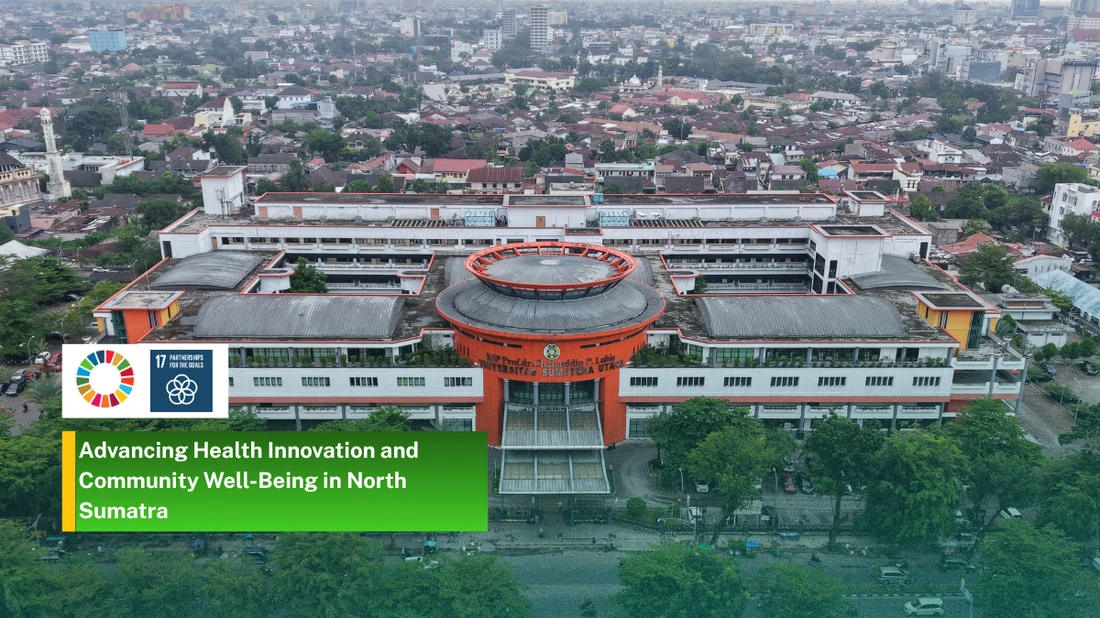
Medan (17 September 2024) - Universitas Sumatera Utara demonstrates its commitment to SDG 3: Good Health and Well-Being by integrating research, innovation, and community programs to improve health for people of all ages. Through advances in medicine, pharmacy, psychology, and public health, USU enhances access to healthcare, promotes disease prevention, and encourages healthy lifestyles. By translating scientific knowledge into practical solutions—from laboratories to local communities—the university strengthens community resilience, supports productive and thriving populations, and ensures that everyone has the opportunity to live healthily, reflecting the essence of sustainable development.
USU Teaching Hospital: Clinical Excellence Powering Community Health
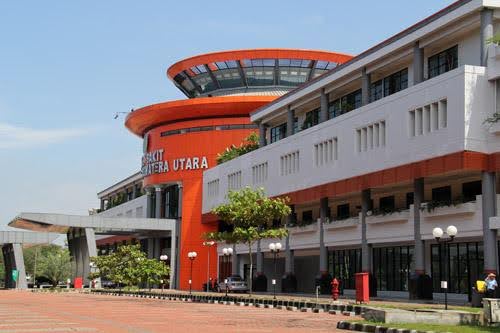
The Universitas Sumatera Utara Teaching Hospital (RS USU) has significantly contributed to public health through its comprehensive medical services and educational mission. As a relatively new academic medical center (opened in 2016), it provides broad healthcare access for the community via multiple specialist clinics and inpatient facilities. The hospital currently operates 17 specialist polyclinics (covering fields such as pediatrics, surgery, obstetrics/gynecology, internal medicine, cardiology, psychiatry, and others) and has over 100 operational beds, serving as a fully accredited Class C hospital. This capacity allows RS USU to treat a high volume of patients – on the order of tens of thousands of visits annually (around 75,000 patient visits per year in recent data). Striving to meet the health needs of North Sumatra’s population, RS USU continually expands and upgrades its services. For example, it has introduced new treatment units such as a chemotherapy service and is investing in minimally invasive surgical techniques (laparoscopic surgery) by procuring advanced equipment.
Beyond routine clinical services, RS USU actively engages in community health programs and medical service innovations. The hospital has implemented special outreach initiatives to improve public health, including free medical treatments and preventive screenings. Notably, RS USU has organized gratis surgical and screening events – for example, it offered free cataract removal operations for dozens of patients and free cardiac examinations (electrocardiogram screening), coupled with a public seminar on proper antibiotic use, as part of a university community service program. Such efforts reflect its commitment to broaden healthcare access, especially for underserved groups.
Health Promotion and Disease Prevention
.jpg)
Universitas Sumatera Utara has adopted a proactive stance in health promotion and disease prevention as essential pillars of SDG 3. A community outreach initiative titled “Healthy Lifestyle Education” was conducted in Desa Bulu Cina (Deli Serdang) through collaboration between the Faculties of Medicine and Public Health. Residents received counselling on diet, exercise, smoking cessation, and routine health monitoring; in addition, basic screenings (blood glucose, cholesterol) were offered, enabling early risk identification for non-communicable diseases (NCDs). Parallel to this, the Faculty of Medicine conducted training for school teachers and pesantren staff on early detection and prevention of cardiovascular and adolescent health conditions, thereby embedding health awareness within the educational sector and contributing to SDG 3.4 (NCD reduction).Women’s Health and Reproductive Care
USU deepened its commitment to women’s health by offering cervical-cancer screening programmes (Pap test) in community clinics and through partnership-based outreach in rural areas. Educational sessions on reproductive health, menopause and early detection of women’s cancers were integrated into community engagement, aligning with SDG 3. These efforts not only increased screening uptake but also fostered informed decision-making among women in underserved areas.
Maternal, Infant and Child Health & Nutrition
.jpg)
Maternal and early-childhood health were advanced by the Faculty of Nursing through breastfeeding preparation classes, offered at health centres (Puskesmas) for expectant mothers and families, and through a “1000 HPK” (first 1000 days of life) mentoring programme employing both in-person training and social-media campaigns. In addition, community-based food processing workshops empowered mothers and health cadres to develop local supplementary foods (cassava-based), thereby strengthening nutritional resilience and supporting child survival and related nutrition targets.
Youth, School and Oral Health Education
.jpg)
USU extended its impact to younger generations through school-based hygiene campaigns. The Faculty of Public Health’s Clean and Healthy Living Behaviour (PHBS) initiative at primary schools introduced hand-washing protocols and food hygiene education, contributing to infectious-disease reduction. Concurrently, the Faculty of Dentistry implemented oral-health programmes such as “Little Dentist” training and teledentistry services during National Dental Health Month (BKGN), offering free check-ups and preventive education to children and community members. These interventions promote oral wellness as a component of general health and equitable access to care.
Equitable Healthcare Access and Community Services
.jpg)
Accessing underserved populations, the Faculty of Pharmacy implemented free health-screening services and health education at the Tanjung Gusta Juvenile Detention Centre (LPKA) and deployed a thematic PKM Skema Perintis outreach in Medan Sunggal, offering check-ups, nutrition counselling and pharmacy services. The Faculty of Medicine integrated mobile medical outreach into regional deployment during anniversary events, conducting screenings and basic treatment in rural locales (e.g., Samosir). These activities uphold the SDG’s principle of leaving no one behind.
Environmental and Occupational Determinants of Health
.jpg)
USU addresses health determinants beyond clinical settings. The Faculty of Public Health led a project constructing a bore-hole well in Pantai Labu (Deli Serdang) to improve access to clean water and reduce water-borne illness, reinforcing clean water alongside. Training for pesticide-spraying farmers improved their occupational health practices and mitigated risks from agrochemical exposure. Disaster-resilience programmes co-led by Public Health and Nursing faculties established Disaster-Resilient Villages (Destana) in high-risk areas, with first-aid training and early-warning education—advancing emergency-response capacity and resilient communities.
Integrated Research and Service Through Synergistic Collaboration
.jpg)
The synergy between research and community service is central to USU’s strategy. Systems for screening, education, and outreach are underpinned by ongoing investigations into health behaviours, technologies, and delivery models. The cross-faculty structure and institutional alignment ensure that innovations are locally adapted and scaled. The 2024 programmes reflect USU’s holistic approach: combining preventive medicine, maternal and child health, youth education, equitable access, and environmental health. Through each sub-component, USU sustains its mission to transform scientific knowledge into actionable, sustained community impact — thereby advancing Good Health and Well-Being within North Sumatra and contributing to national SDG progress.
Natural-Based Medical Innovations for Human Health
Universitas Sumatera Utara continues to expand its global contribution to Sustainable Development Goal 3 (Good Health and Well-Being) through research that integrates science, technology, and local biodiversity.
Among its most remarkable achievements is the creation of kombucha from soursop leaves and honey, a natural beverage with proven antioxidant and antimicrobial properties that supports immune system resilience. Complementing this, USU researchers developed an innovative membrane derived from the grass jelly plant that accelerates wound healing while minimizing infection risk—an affordable and eco-friendly alternative for clinical care.
Further studies revealed the potential of African leaf extracts in treating pancreatic cancer and the use of sweet melon fruit compounds as a natural defense against sepsis, one of the world’s leading causes of hospital mortality. In radiation medicine, the Aloe vera and Daikon gel formulation has demonstrated significant results in protecting patients from radiation dermatitis, marking another milestone in the development of plant-based therapeutic solutions.
Frontier Research: Biotechnology and Regenerative Medicine
USU’s medical scientists are pioneering innovative therapies that address chronic and life-threatening diseases. Through mesenchymal stem cell (MSC) therapy, researchers have made groundbreaking progress in treating lupus, an autoimmune disorder that affects thousands of Indonesians. Meanwhile, exploration into Andaliman (Zanthoxylum acanthopodium), a native spice from North Sumatra, has revealed strong bioactive properties with potential application in cervical cancer treatment.
Complementary studies on Propolis—an ancient natural compound—bridge traditional medicine with modern science, demonstrating its antioxidant and immunomodulatory effects. Together, these discoveries showcase USU’s strength in transforming local natural resources into global health innovations, contributing to the future of personalized and regenerative medicine.
Accessible and Equitable Dental Health Care Services For Students dan Community
.jpg)
USU’s Faculty of Dentistry (FKG USU), through the IKGA Community Service Program, has consistently provided free dental examinations, treatment, and health education for children in underserved areas. These outreach efforts directly enhance oral health literacy and reduce preventable dental diseases among vulnerable populations.
Additionally, research on cochlear measurement for implant surgery improves the success rate of hearing restoration procedures, emphasizing USU’s role in advancing inclusive and precision healthcare for all.
Through its extensive portfolio of medical research, technological innovation, and community engagement, Universitas Sumatera Utara demonstrates how academic institutions can play a transformative role in improving global health. From herbal therapeutics and regenerative medicine to digital innovation and public health campaigns, USU continues to embody its vision of “knowledge for humanity.” These collective efforts not only contribute to the achievement of SDG 3 (Good Health and Well-Being) but also strengthen Indonesia’s position as a center of health innovation, scientific excellence, and social compassion.