


Medan, 29 November 2024 -- Water is the essence of life and a cornerstone of sustainable development. Recognizing its fundamental role in human health, environmental stability, and economic resilience, Universitas Sumatera Utara has placed Sustainable Development Goal 6 (Clean Water and Sanitation) at the heart of its research and community innovation agenda. Guided by the principle that “clean water is not merely a resource, it is the foundation of life, resilience, and sustainable development,” USU strives to create science-based solutions that ensure the sustainable use, protection, and equitable distribution of water resources for present and future generations.
Securing Water for a Sustainable Campus: USU’s SDG 6 Actions on Supply, Efficiency, and Safety
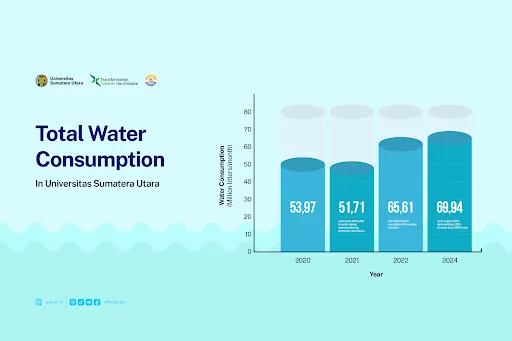
Universitas Sumatera Utara operates an integrated campus water system anchored by the municipal supply and campus-wide metering, enabling accurate monthly and annual accounting. Complementary sources include rainwater harvesting at facilities such as the Engineering complex, the Information Study Centre, and the Mini Stadium, as well as recycled wastewater at the Digital Learning Center for toilet flushing and landscape irrigation. Water infrastructure—including retention ponds, infiltration wells, biopores, and reservoirs at Kuala Bekala and Tambunan A—reduces runoff and supports groundwater recharge, while systematic leak repair and sensor-based devices promote conservation. Active monitoring shows average consumption declined from 53.97 to 51.71 million liters per month (2020–2021), increased with post-pandemic campus reopening to 65.61 million liters (mid-2022), and reached 69.94 million liters in August 2024, approximately 35 percent higher than in 2021.
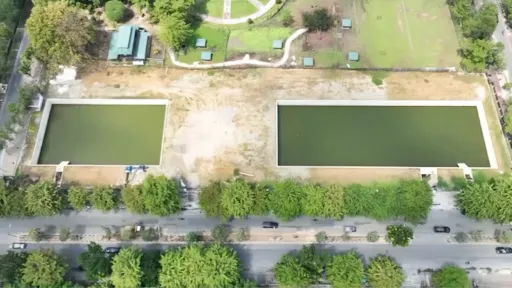
USU prevents pollution through distributed wastewater treatment compliant with national standards (Ministerial Regulation P.68/2016) and verified by third-party audits (SUCOFINDO, provincial environmental agency). Key assets include the STP at the Digital Learning Center; a 150 m³/day extended-aeration WWTP at the Teaching Hospital (pretreatment, aeration, sedimentation, chlorination, post-treatment/fishpond, sludge handling); a dedicated laboratory WWTP at the Faculty of Pharmacy; bio-technology STP at the Dental and Oral Hospital; and a compact Johkasou system at Environmental Engineering (via JICA). Routine inspections of pH, ammonia, COD, BOD, TSS, and coliform, together with retention ponds and infiltration wells, provide layered safeguards, even under incident scenarios.
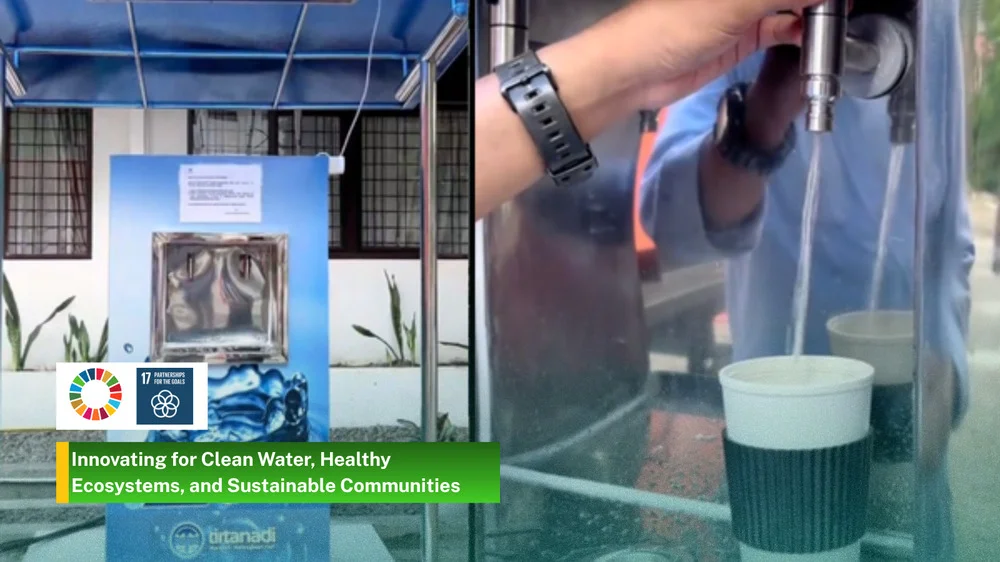
To ensure equitable access and cut plastic waste, USU provides free drinking-water refills and bans single-use bottled water under Rector’s Regulation No. 3/2019 (Green Campus Movement). Refill stations across faculties enable students, staff, and visitors to use personal tumblers, lowering both costs and environmental footprint. These measures, supply diversification, rigorous treatment and compliance, demand-side efficiency, and plastic-free hydration, demonstrate USU’s structured delivery of SDG 6, coupling operational reliability with environmental stewardship and public health protection.
Solar Still: Turning Seawater into Freshwater
The Solar Still project reflects USU’s leadership in developing renewable and nature-based solutions to address the freshwater scarcity crisis. In many coastal regions of Indonesia, rising sea levels and saltwater intrusion have made groundwater unsuitable for consumption. USU researchers designed a solar-powered distillation unit that transforms seawater into clean drinking water using the natural process of evaporation and condensation powered by sunlight.
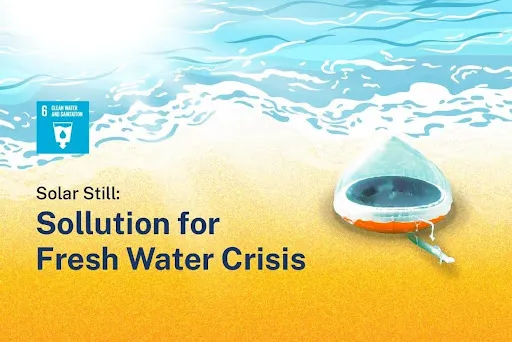
This technology requires no electricity or chemicals, making it cost-efficient, environmentally friendly, and accessible to remote coastal and island communities. It can be constructed using locally available materials, such as glass panels, aluminum sheets, and insulated containers, making it a scalable solution adaptable to various climates.
The Solar Still technology ensures clean and safe drinking water for households affected by drought, climate shocks, or poor infrastructure. It reduces reliance on bottled water, lowers household expenses, and provides a sustainable water source during disaster emergencies. For coastal farmers, this technology also supports small-scale irrigation and livestock hydration, helping stabilize food production even in saline-prone regions. Beyond immediate benefits, Solar Still enhances community independence in water management, fostering local innovation and resilience against the growing threat of water scarcity and climate change.
Developing a Specific Water Quality Index for Tropical Coastal Lakes
In an era where water ecosystems face increasing stress from pollution, urbanization, and climate change, Universitas Sumatera Utara has pioneered a new standard in environmental monitoring through the development of the Specific Water Quality Index (SWQI) for tropical coastal lakes. Unlike conventional indices that are often designed for temperate regions, SWQI introduces parameters that are adapted to tropical environments, such as higher temperatures, seasonal rainfall variation, sedimentation rates, and nutrient loads specific to coastal hydrology.
This scientific tool integrates biological, chemical, and physical indicators, including dissolved oxygen, pH, chlorophyll content, and organic pollution levels, to offer a holistic assessment of lake health. By employing regionally calibrated thresholds, the SWQI helps detect early signs of ecosystem degradation, enabling timely interventions for conservation and management.

The SWQI plays a vital role in sustaining aquatic biodiversity and community livelihoods. Many fishing villages and agricultural sectors in Indonesia depend on these lakes for freshwater and food production. By monitoring water quality with precision, local authorities can protect fish stocks, irrigation networks, and human health. Additionally, the data supports environmental education, empowering communities to participate in conservation initiatives. This innovation directly strengthens evidence-based policy for integrated water resource management and contributes to climate resilience in coastal ecosystems, ensuring the continuity of life and livelihoods that depend on clean and balanced water systems.
Responding to Micropollutant Emergencies: Hazards and Mitigation Strategies
As industrialization and urban expansion continue, micropollutants, tiny yet toxic contaminants like microplastics, pharmaceuticals, heavy metals, and industrial residues, have emerged as a critical threat to freshwater safety. Through the research titled “Micropollutant Emergency: Hazards and Response Measures,” USU scientists identified contamination patterns across rivers, lakes, and groundwater systems in tropical settings. The study provides both an early warning framework and scientifically validated mitigation measures for policymakers and water management authorities.
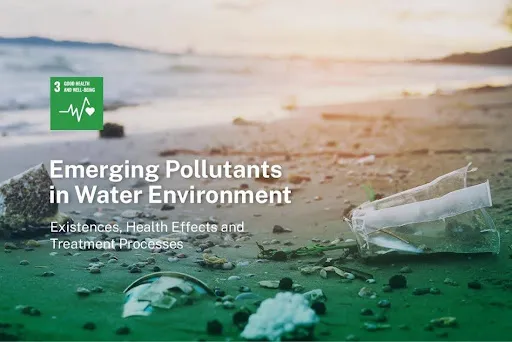
Researchers evaluated pollutant concentrations, pathways, and potential biological effects, proposing solutions such as biofiltration systems, adsorption technologies, and stricter waste management protocols. These innovations not only enhance environmental protection but also contribute to long-term public health security.
This initiative protects millions of people who rely on surface and groundwater sources for daily consumption. By identifying and mitigating micropollutant risks, the project helps prevent chronic illnesses, endocrine disruptions, and ecological imbalances. Communities benefit from cleaner water, safer food chains, and improved environmental quality. Furthermore, the research fosters public awareness campaigns, educating citizens on responsible waste disposal and the dangers of chemical pollution, thereby promoting a culture of preventive action and sustainability.
Exploring Waste Potential: Revolutionizing Fecal Waste Treatment
In collaboration with partner institutions in Malaysia, USU researchers are revolutionizing the way human waste is managed through the project “Exploring Waste Potential.” This initiative applies circular economy principles to transform fecal sludge into valuable resources such as organic fertilizer, compost, and biogas. Using advanced treatment techniques like anaerobic digestion, drying beds, and microbial bioconversion, the project redefines waste as a renewable source of energy and soil nutrients.
This breakthrough directly enhances sanitation infrastructure in urban and peri-urban areas, reducing pollution of rivers and groundwater caused by untreated sewage. By turning waste into resources, communities not only achieve cleaner environments but also generate economic value through local fertilizer production and renewable energy for households. The initiative mitigates the spread of waterborne diseases, such as cholera and diarrhea, and improves hygiene standards for marginalized communities.
It also supports gender-inclusive benefits, as women, often the most affected by poor sanitation, gain safer facilities and healthier living environments. The project showcases how technology and international collaboration can turn one of humanity’s oldest challenges into a source of sustainable growth and dignity.
Oil Palm Shell Powder: A Green Solution for Seawater Purification
Indonesia’s palm oil industry generates tons of waste annually, much of which remains unused. USU researchers have innovatively transformed this waste into an eco-friendly water purification material through the development of Oil Palm Shell Powder (OPSP). The material acts as a natural bio-adsorbent, capable of filtering out salt, heavy metals, and suspended solids from seawater, making it a sustainable and affordable solution for water purification.
Laboratory trials demonstrated that OPSP can reduce turbidity and contamination levels to meet World Health Organization (WHO) drinking water standards. Because it is biodegradable and easy to reproduce, OPSP offers a long-term alternative to synthetic filtration materials that often end up polluting the environment after use.
This innovation bridges the gap between agricultural waste management and clean water access. For rural and coastal communities, it ensures safe water for household use, aquaculture, and irrigation, while creating new livelihood opportunities through small-scale filter production. Environmentally, OPSP reduces the carbon footprint of palm oil waste and prevents landfill accumulation.
Economically, it stimulates local green industries, supporting Indonesia’s circular economy and sustainable resource use. In the long term, OPSP contributes to environmental stewardship and community empowerment, showing how waste can be transformed into life-sustaining innovation.