


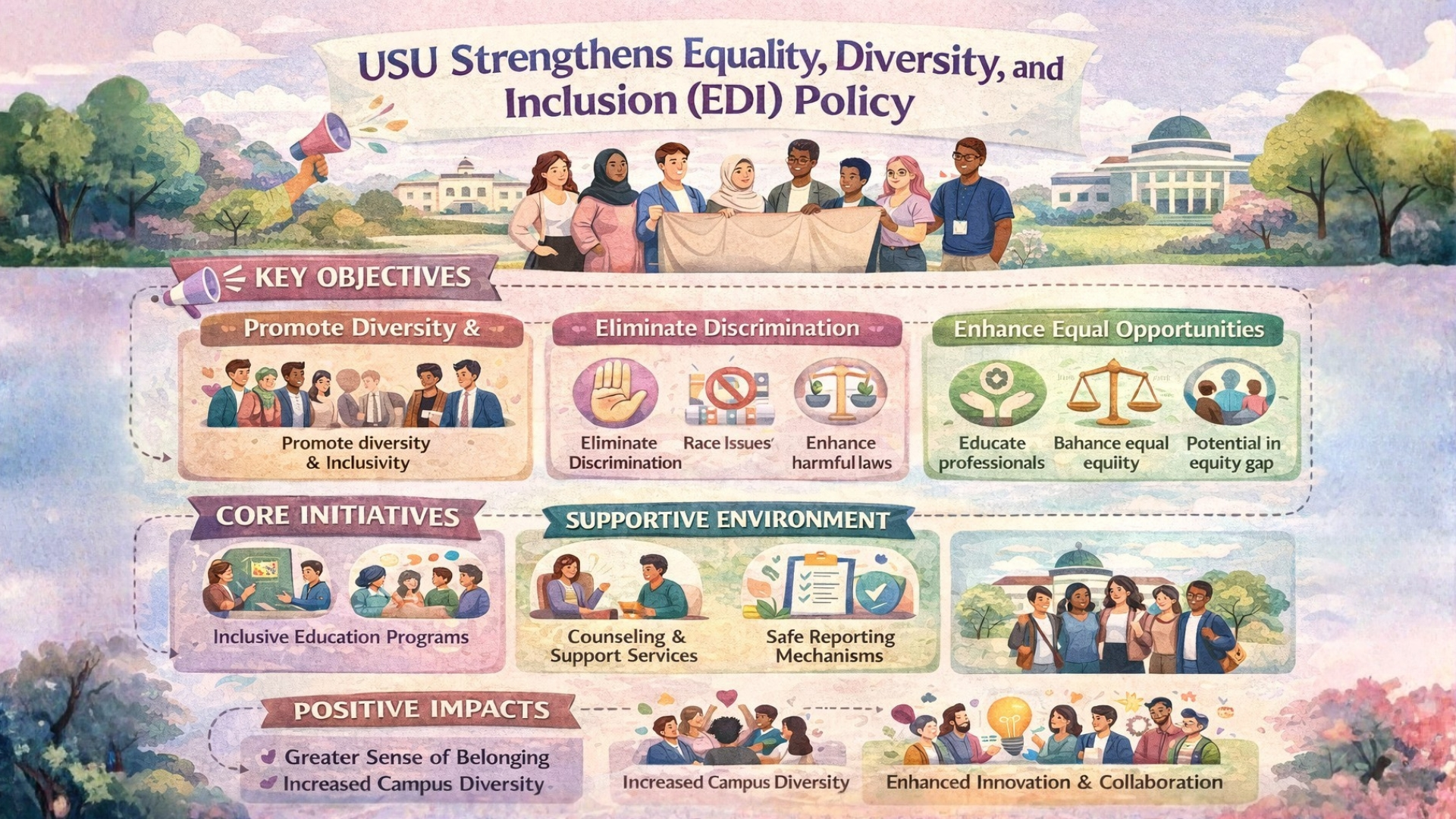
Meanwhile, KEPTOR No. 3135/2024 on services for students with disabilities directly operationalizes inclusion by guaranteeing accessible academic support systems. Regulations like PERTOR No. 16/2025 and KEPTOR No. 3289/2024 on violence prevention reinforce a safe and respectful campus environment, aligning with EDI values of dignity and non-discrimination.
https://dithukor.usu.ac.id/id/dokumen/keputusan-rektor
In addition, governance-related policies such as PERTOR No. 20/2023 on public information transparency
and PERTOR No. 8/2023 on campus safety contribute to an inclusive institutional climate where all individuals, regardless of gender, age, disability, ethnicity, religion, or social status, can participate fully and equitably. Academic regulations across diploma, undergraduate, master’s, doctoral, and professional programs (PERTOR No. 20–24/2025) further ensure that inclusivity is consistently applied throughout the student lifecycle. Altogether, these regulations form a holistic EDI framework that positions diversity as a structural strength, fostering both academic excellence and social cohesion within the university.
Comprehensive EDI Policy Framework
USU’s EDI policy encompasses a wide range of inclusion indicators, including
Age
At Universitas Sumatera Utara, the age dimension of EDI is reflected in its non-discriminatory academic policies, where admission and participation are based on merit rather than age. Regulations such as PERTOR No. 43/2017 and PERTOR No. 5/2022 ensure equal access to education for all age groups, while flexible academic pathways support lifelong learning and the inclusion of mature students.
Gender
Disability
Race or Ethnic background
Religion and belief
https://suarausu.or.id/natal-oikumene-usu-2025-gaungkan-kasih-dan-persatuan-lintas-batas/
Sexual orientation
Marital status
https://sdgs.usu.ac.id/en/sdgs/sdgs-5
Refugee or vulnerable backgrounds
https://sdgs.usu.ac.id/en/sdgs/sdgs-16
Pregnancy
This holistic approach positions diversity as a strategic institutional strength that enriches both academic excellence and social cohesion within the university. Universitas Sumatera Utara (USU) continues to strengthen its commitment to disability inclusion through its collaboration with the National Commission on Disability since 2022.
USU emphasized the university’s commitment to establishing a Disability Service Unit (ULD), allocating a dedicated budget, and expanding disability-friendly facilities across the rectorate and faculties. According to KND data, despite the large number of persons with disabilities in Indonesia, the participation of students with disabilities in higher education remains limited. While appreciating USU’s progress, KND also encouraged further improvements, including better infrastructure accessibility, broader inclusion of various types of disabilities, and the integration of inclusive curricula in line with Ministerial Regulation No. 48 of 2023. This collaboration is expected to serve as a strong foundation for fostering an equitable, inclusive, and sustainable higher education environment for all students.
https://www.usu.ac.id/en/news/usu-knd-strengthen-commitment-to-realize-an-inclusive-campus
https://sdgs.usu.ac.id/en/news/usu-upholds-inclusive-non-discrimination-principles-supporting-all-individuals-regardless-of-gender-identity
Institutional Commitment and Governance
The university integrates non-discrimination principles into its governance system through formal regulations, including Peraturan Rektor Universitas Sumatera Utara Nomor 3 Tahun 2019 tentang Peraturan Kepegawaian and Surat Edaran Rektor Nomor 1 Tahun 2023 tentang Penguatan Nilai-Nilai Etika, Kesetaraan, dan Anti Diskriminasi di Lingkungan USU. These policies clearly define the rights and responsibilities of the academic community and guarantee equal access to education, employment opportunities, career progression, and participation in academic and non-academic activities without discrimination. EDI is a fundamental pillar in achieving the university’s vision as a globally competitive higher education institution.
Programs Supporting Inclusion
Beyond formal regulations, USU actively implements various supporting programs, such as diversity awareness training, assistance services for students with disabilities, and interfaith and intercultural dialogue forums. These initiatives ensure that EDI values are embedded in everyday campus life, transforming policy into tangible practices. Transparent Reporting and Accountability to uphold accountability, USU has established transparent and accessible mechanisms for reporting and addressing discrimination. Members of the academic community are provided with clear channels to report grievances, which are handled through structured, fair, and confidential procedures. This system strengthens trust and ensures a safe campus environment.
EDI framework relate to SDGs 5 (Gender Equality) and SDG 10 (Reduced Inequalities) SDGs 16 (Peace, Justice, and Strong Institutions)