About Goals
The "Climate Action" program is one of the flagship programs of the Universitas Sumatera Utara (USU) in supporting the achievement of Sustainable Development Goals (SDGs). With an important background in facing the challenges of climate change in Indonesia. Indonesia is a country that is significantly affected by climate change, such as rising global temperatures, rising sea levels, and changes in extreme weather patterns. So through this program, it is aimed at overcoming climate change and its negative impacts in Indonesia. USU is committed to becoming an agent of change by conducting research, education, and developing innovations that focus on climate change mitigation and adaptation. Through collaboration with government, industry and society, USU seeks to increase understanding of climate change, promote environmentally friendly policies, and develop sustainable solutions to reduce greenhouse gas emissions and strengthen resilience to climate change.
Universitas Sumatera Utara's Action to the SDGs
Low Carbon Energy Use
Low Carbon Energy Tracking
USU systematically measures, monitors, and reports low carbon energy use as part of its Green Campus initiatives. The 2024 Green Campus Performance Report recorded total consumption of 2,984,732 gigajoules, with 53,543 gigajoules derived from low-carbon renewable sources, primarily solar photovoltaic systems installed on rooftops, bus shelters, and Smart Classrooms. These photovoltaic installations are integrated with real-time smart energy monitoring systems that track energy use for optimization and emission reduction. The analytics dashboard provides continuous data on renewable generation, savings, and carbon offset performance. USU also implements energy-efficient lighting, automatic climate controls, and motion-sensor systems. These efforts demonstrate USU’s strong commitment to reducing fossil fuel dependency, enhancing energy efficiency, and advancing toward its long-term carbon neutrality target.
Total Energy Used
2,984GJ
Total Energy Used from Low-Carbon Sources
147GJ
Environmental Education Measures
Local Education Programmes on Climate
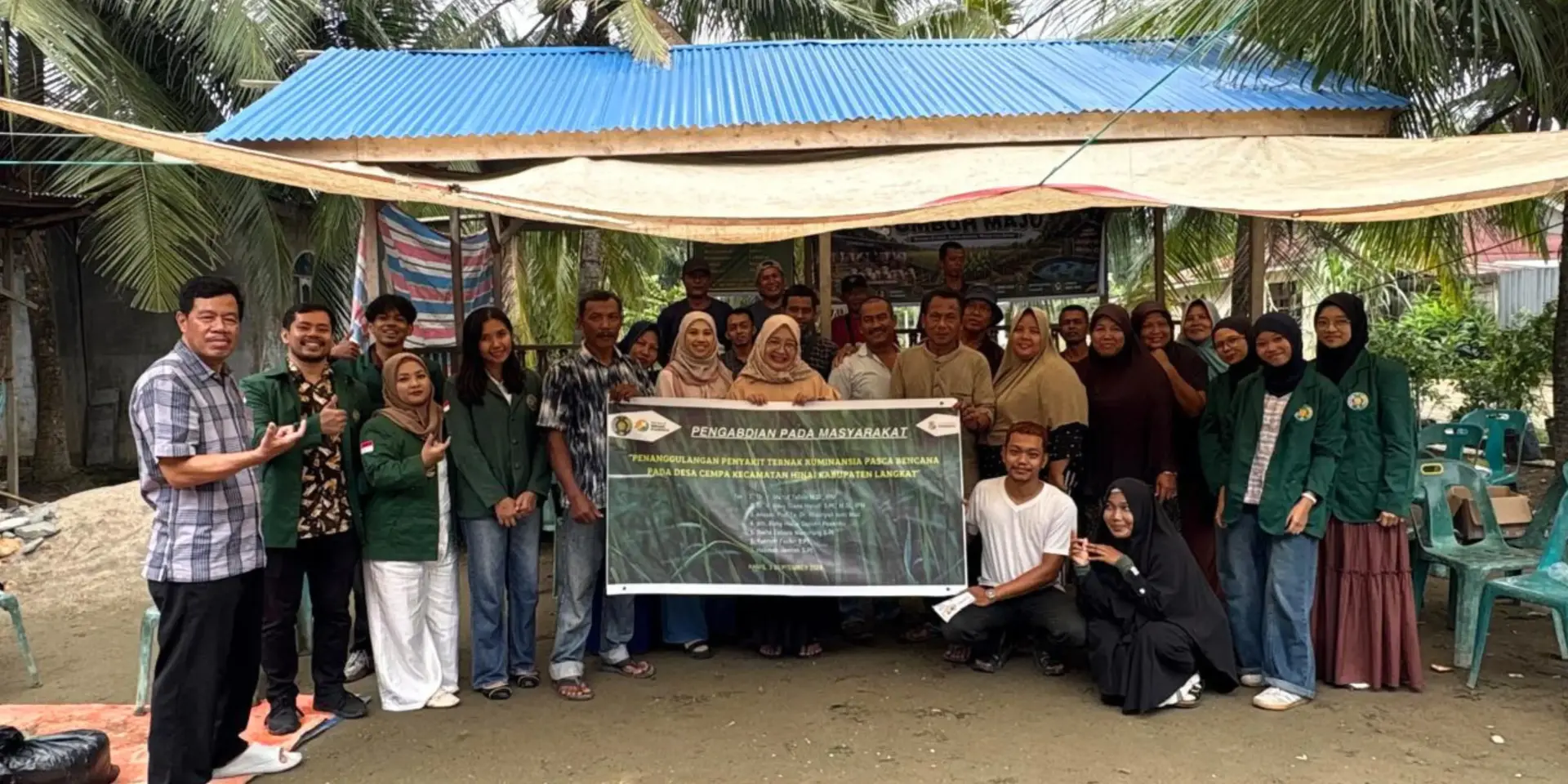
USU provides educational programmes and local campaigns that strengthen awareness and preparedness regarding climate change risks, impacts, mitigation, and adaptation. USU actively engages academic and local communities through public lectures, seminars, and community-based outreach promoting climate literacy. A notable example is the public lecture, “Biomass Potential as an Alternative Energy Source in Efforts to Mitigate Climate Change”, attended by over200 participants. The event focused on organic waste-to-energy conversion using the Waste Processing at Source method, promoting sustainable biomass utilization and emission reduction. Beyond lectures, USU integrates environmental risk communication, forest resilience, and disaster adaptation education into its Community Service and Research Programme activities. These efforts enhance public capacity for early warning and ecological adaptation while fostering cross-disciplinary collaboration in sustainability education.
Climate Action Plan, Shared
USU has embedded its Climate Action Plan within the Green Campus Implementation Regulation (Rector’s Regulation No. 3 of 2019). The plan focuses on reducing carbon emissions, transitioning to renewable energy, and improving waste management. USU collaborates closely with the Regional Planning Agency to develop the Regional Action Plan for sectors like agriculture, waste reduction, and mercury elimination. Forestry and Environmental Science Faculties contribute through climate resilience modeling, carbon sequestration research, and reforestation. USU's integrated approach, combining academic, operational, and policy engagement, functions effectively as an institutional and regional Climate Action framework.
Co-operative Planning for Climate Change Disasters
USU actively participates in cooperative planning for climate change-related disasters and displacement through research, technical support, and policy engagement. As documented in the 2024 sustainability report, USU via the Faculty of Forestry contributed to the Sustainable Use of Peatland and Haze Mitigation in ASEAN Project. This involved formulating Regional Spatial Plans for Aceh Barat and Nagan Raya, coordinating with the Ministry of Environment and Forestry, University of Syiah Kuala, and German Development Cooperation. The project focused on resilience building and reducing climate induced displacement by improving peatland management to prevent haze, land degradation, and forced migration. Additionally, USU’s research includes climate risk mapping, environmental modelling, and ecosystem assessment to strengthen disaster preparedness and inform local government planning. These initiatives align with Sustainable Cities and Communities and Climate Action goals.
Inform and Support Government
USU actively informs and supports local/regional governments in climate change disaster risk early warning, monitoring, and response planning through research and technical assistance. In 2024, USU via the Faculty of Forestry and Research Center for Disaster Mitigation organized a regional workshop on Integrated Early Warning Systems in North Sumatra. The event gathered the Regional Disaster Management Agency, Regional Development Planning Agency, and experts to develop data-driven monitoring of floods, peatland fi res, and ecosystem vulnerability. USU introduced predictive models for risk mapping, adopted by regional agencies to enhance preparedness and alert systems. USU collaborates with local authorities to design real-time monitoring platforms integrating satellite and IoT-based systems. These initiatives demonstrate USU’s commitment to climate action, sustainable cities, and resilient communities by strengthening adaptive governance.
Environmental Education Collaborate with NGO
USU actively collaborates with non-governmental organizations on climate adaptation, resilience, and sustainable development through research and community engagement. In 2024, USU received national recognition as a Silver Winner in the Collaboration Award by the Ministry of Education, Culture, Research, and Technology. Key initiatives include the Faculty of Forestry's partnership with German Development Cooperation and the University of Syiah Kuala to improve peatland management, mitigate haze, and strengthen community resilience. USU also works with local NGOs like the Sustainable Ecosystem Foundation and the Sumatera Rainforest Institute on joint seminars and field projects on sustainable land use and adaptive environmental management. These collaborations reinforce USU’s leadership as a hub for climate education, ecosystem restoration, and community resilience.
Commitment to Carbon Neutral University
Commitment to Carbon Neutral University
USU has officially committed to achieving full carbon neutrality by 2029, as mandated by the Rector’s Circular Letter No. 1 of 2023. This initiative follows the stringent Greenhouse Gas Protocols (Scope 1, 2, and 3) and will align reporting with ISO 14064 standards for global accountability. USU's roadmap prioritizes energy transition and efficiency, featuring: Solar energy expansion. Energy-efficient building designs, The "Go Ride Electricity Program" for zero-emission transport. Complementary eff orts include enhancing waste-to-resource programs and performing annual carbon assessments. Through this structured approach, USU establishes institutional leadership in advancing climate action and sustainable campus management in Indonesia.
Achieve by date
USU has a commitment stated in the Rector's Circular Letter no. 1 of 2023 to achieve carbon neutrality with scope 1, scope 2, and scope 3 partially with a target achievement in 2029.
SDGs Articles


Activities
.webp)
.webp)
PRIORITY STATEMENTS
Indonesia membutuhkan Anda, para akademisi yang berkomitmen untuk membawa perubahan nyata. Kami mengundang Anda untuk berbagi penelitian, inovasi, dan ide-ide brilian Anda guna melawan kemiskinan, meningkatkan kesejahteraan sumber daya manusia (SDM) dalam negeri, dan menyukseskan masa depan Republik Indonesia.
Infographic
Research and Publications
Natural resources, green innovation, fintech, and sustainability: A fresh insight from BRICS
Lisha L., Mousa S., Arnone G., Muda I., Huerta-Soto R., Shiming Z.
Sustainable Development Goals and Green Sustainable Supply Chains: a Review
Sembiring N., Junika C., Azmi N.N.
Analysis of the relationship between urban heat island (UHI) phenomenon and land cover change in Medan city using Landsat satellite imagery
Pohan S.A., Sulistiyono N.
Spatial Distribution of Flood Vulnerability in Langkat Regency, North Sumatera Province, Indonesia
Thoha A.S., Slamet B., Harahap M.M., Sari T.Y., Hulu D.L.N.
Study of slope failure in two regions: A comparative study between Penang Island Malaysia and North Sumatera Indonesia
Ahmad F., Hastuty I.P.
The Use of Kenaf Fibre as a Natural Anti-Degradant in Recycled High-Density Polyethylene and Natural Rubber-Based Thermoplastic Elastomers
Hayeemasae N., Viet C.X., Masa A., Shuib R.K., Ismail H., Surya I.
The Mars method approach in the analysis of earthquake hazard predictions in Sumbawa
Priyanto D., Zarlis M., Efendi S.
Studying on the Carbon Black-Reinforced Styrene Butadiene Rubber: Effect of Stearamide Adding on the Rheological Behavior
Surya I., Ginting M.
The Effect of Ethylenediamine as Passivation Agent on the Optical Properties of Carbon Dots from Molasses Using the Microwave Method
Marpongahtun, Azizah N., Amaturahim S.A., Sartina, Purwandari V.
Optimization of the Crude Palm Oil Supply Chain Using a Mixed Integer Linear Programming Model
Lilis L., Sutarman S., Suwilo S., Sitompul O.S.
Impacts of industrial production and air quality by remote sensing on nitrogen dioxide concentration and related effects: An econometric approach
Kurniawan R., Budi Alamsyah A.R., Fudholi A., Purwanto A., Sumargo B., Gio P.U., Wongsonadi S.K., Hadi Susanto A.E.
Latest Advancements in the Development of High-Performance Lignin- and Tannin-Based Non-Isocyanate Polyurethane Adhesive for Wood Composites
Iswanto A.H., Lubis M.A.R., Sutiawan J., Al-Edrus S.S.O., Lee S.H., Antov P., Kristak L., Reh R., Mardawati E., Santoso A., Kusumah S.S.
Characterization and Application of Non-Formaldehyde Binder Based Citric Acid, Maleic Acid, and Molasses Adhesive for Plywood Composite
Sutiawan J., Syahfitri A., Purnomo D., Sudarmanto, Narto, Akbar F., Triwibowo D., Ismadi, Amanda P., Kusumah S.S., Lubis M.A.R., Hermawan D., Sulastiningsih I.M., Nuryawan A., Hakim L.
Ternary alloyed BaxCd1−xS nanocrystals: Synthesis, bandgap tuning, and photovoltaic performance
Rahayu S.U., Tai Y.-L., Boon-On P., Wang Y.-R., Lee M.-W.
Akreditasi Fasilkom-TI